


Thank you for purchasing the Grandstream GXW42XX Analog FXS IP Gateway. The GXW42XX offers an easy-to-manage, easy-to-configure IP communications solution for any business with virtual and/or branch locations. The GXW42XX supports popular voice codecs and is designed for full SIP compatibility and interoperability with third-party SIP providers, thus enabling you to fully leverage the benefits of VoIP technology, integrate a traditional phone system into a VoIP network, and efficiently manage communication costs.
This manual will help you learn how to operate and manage your GXW FXS Analog IP Gateway and make the best use of its many upgraded features, including simple and quick installation, multi-party conferencing, and direct IP-IP Calling. This IP Analog Gateway is very easy to manage and scalable, specifically designed to be an easy-to-use and affordable VoIP solution for the small – medium business or enterprise.
GATEWAY GXW42XX OVERVIEW
The new GXW42XX series has a compact and quiet design and offers superb audio quality, rich feature functionality, strong security protection, and good manageability. It is auto-configurable, remotely manageable, and scalable.
The GXW42XX series features 16, 24, 32, or 48-port FXS interface for analog telephones, dual 10/100/1000Mbps network ports, and an RJ21 analog port. In addition, it supports the option of 4 SIP Server profiles, caller ID for various countries/regions, T.38 fax, flexible dialing plans, security protection (SIPS/TLS), comprehensive voice codec including G.711 (a/u-law), G.723.1, G.726(16/24/32/40 bit rates), iLBC and G.729.
CONNECT YOUR GXW42XX GATEWAY
Connecting the GXW42XX gateway is easy. Before you begin, please verify the contents of the GXW42XX package.
Equipment Packaging
Unpack and check all accessories. Equipment includes:
- 1 × GXW42xx V1/GXW42xx V2 Device Unit
- 1 × RJ45 Ethernet Cable
- 1 × Power Adapter
- 12V 5A universal adapter (for all models except GXW4248 V1/V2)
- 24V 6.25A adapter (for GXW4248 V1 and V2 only)
- 2 × Rack Mount Brackets
- 2 × Telco Cables (included with GXW4248 V1 and V2 only)
- 1 × Quick Installation Guide
- 1 × Regulatory Paper


Connect the GXW42XX
Follow these four (4) steps to connect your GXW42XX gateway to the Internet and access the unit’s configuration pages.
- Connect standard touch-tone analog phones to the GXW42XX’s RJ21 port with an RJ11 to RJ21 cable.
- Insert an RJ45 Ethernet cable into the WAN port of GXW42XX and connect the other end to an uplink port (a router or a modem, etc.)
- Plug the power adapter into the GXW42XX gateway in a power outlet.
Follow the instructions from the topic “Configuring GXW 42XX with Web Browser” for initial configuration. The GUI pages will guide you through the remaining steps to set up your gateway.
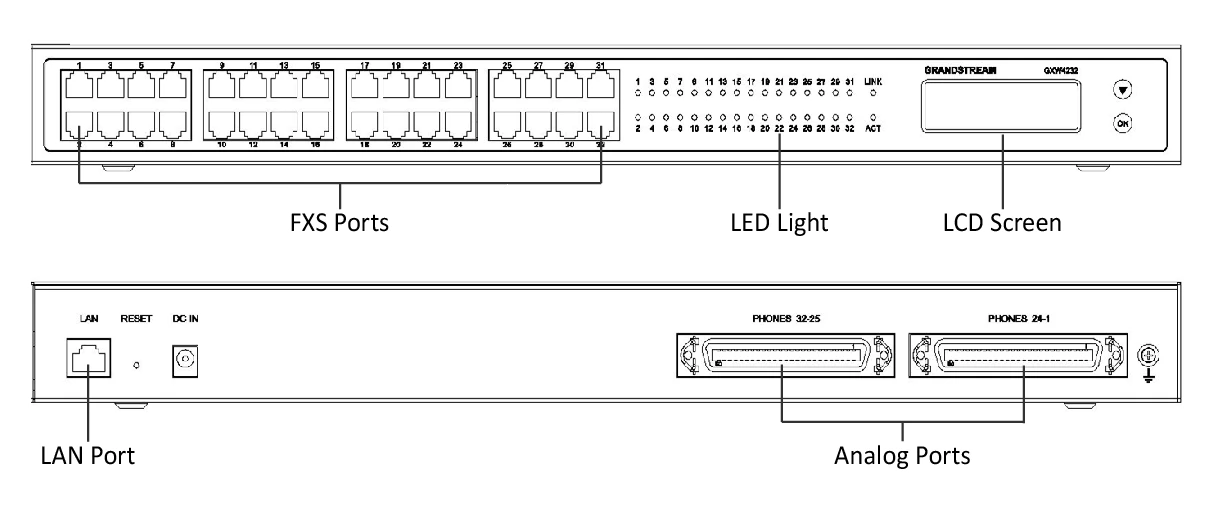
Ethernet Port | Connect to the internal LAN network or router |
RESET | Factory Reset button. Press and hold for a while to reset factory default settings. |
DC IN | Power adapter connection |
Analog Port | Connect to analog phones / fax machines with an RJ21 to RJ11 cable |
FXS Ports | FXS port to be connected to analog phones / fax machines. |
Definitions of the GXW Connectors
Act LED | Remains ON if plug the network cable. |
LINK LED | Indicates Ethernet port activity. |
FXS LED | Indicate status of the respective FXS Ports on the back panel
Busy – ON (Solid Green) Available – OFF
Slow blinking FXS LEDs indicates Voice Mail for that port.
All FXS LEDs slow blinking indicates provisioning. |
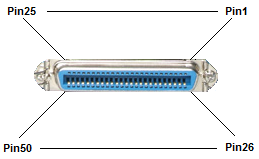
Pin | Signal | Pin | Signal |
1 | RING1 | 26 | TIP1 |
2 | RING2 | 27 | TIP2 |
3 | RING3 | 28 | TIP3 |
4 | RING4 | 29 | TIP4 |
5 | RING5 | 30 | TIP5 |
6 | RING6 | 31 | TIP6 |
7 | RING7 | 32 | TIP7 |
8 | RING8 | 33 | TIP8 |
9 | RING9 | 34 | TIP9 |
10 | RING10 | 35 | TIP10 |
11 | RING11 | 36 | TIP11 |
12 | RING12 | 37 | TIP12 |
13 | RING13 | 38 | TIP13 |
14 | RING14 | 39 | TIP14 |
15 | RING15 | 40 | TIP15 |
16 | RING16 | 41 | TIP16 |
17 | RING17 | 42 | TIP17 |
18 | RING18 | 43 | TIP18 |
19 | RING19 | 44 | TIP19 |
20 | RING20 | 45 | TIP20 |
21 | RING21 | 46 | TIP21 |
22 | RING22 | 47 | TIP22 |
23 | RING23 | 48 | TIP23 |
24 | RING24 | 49 | TIP24 |
50 Pin Telco Connector
GXW42XX FEATURES
The GXW42XX is a next-generation IP voice gateway that is interoperable and compatible with leading IP-PBXs, Soft switches, and SIP platforms. The GXW42XX FXS gateway is auto-configurable, remotely manageable, and scalable. The GXW42XX gateways come in four models – the GXW4216, GXW4224, GXW4232and GXW4248, each offering superb voice quality, traditional telephony functionality, easy deployment, and 16, 24, 32, and 48FXS ports, respectively. Each model features flexible dialing plans, integrated call routing to support a pure IP network call, and an external power supply.
Software Features Overview
- 16, 24, 32, or 48FXS ports (no front panel FXS ports on GXW4248)
- RJ-45 Ethernet ports
- 4 configurable SIP profiles
- Supports Voice Codecs:
G711 (a/µ, Annex I & II), G723.1A, G726 (ADPCM with 16/24/32/40 bit rates), G729 A/B, iLBC, T.38 Fax
- Comprehensive Dial Plan support for Outgoing calls.
- G.168 Echo Cancellation,
- Voice Activation Detection (VAD), Comfort Noise Generation (CNG), and Packet Loss Concealment (PLC)
- Supports PSTN/PBX analog telephone sets or analog trunks
GXW4216 | GXW4224 | GXW4232 | GXW4248 | |
Telephone Interfaces | 16 FXS ports | 24 FXS ports | 32 FXS ports | 48 FXS ports |
SIP Provisioning | 16 SIP accounts, 4 profiles | 24 SIP accounts, 4 profiles | 32 SIP accounts, 4 profiles | 48 SIP accounts, 4 profiles |
Network Interface | 10/100/1000 Mbps, RJ-45 | |||
Number of Concurrent Calls (except when using SRTP) | 16 Concurrent Calls | 24 Concurrent Calls | 32 Concurrent Calls | 48 Concurrent Calls |
Voice over Packet Capabilities | Voice Activity Detection (VAD) with CNG (comfort noise generation) and PLC (packet loss concealment), LEC with NLP Packetized Voice Protocol Unit (supports RTP and AAL2 protocol), G.168 compliant Echo Cancellation, Dynamic Jitter Buffer, Modem detection & auto-switch to G.711 | |||
Voice Compression | G.711 + Annex I (PLC), Annex II (VAD/CNG format) encoder and decoder, G.722, G.723.1A, G.726(ADPCM with 16/24/32/40-bit rates), G.729, iLBC, G.726 provides proprietary VAD, CNG, and signal power estimation, Voice Play Out unit (reordering, fixed and adaptive jitter buffer, clock synchronization), AGC (automatic gain control), Status output, Decoder controlling via voice packet header | |||
DHCP Server/Client | DHCP Client only | |||
Fax over IP | T.38 compliant Group 3 Fax Relay up to 14.4kpbs and auto-switch to G.711 for Fax Pass-through, Fax Datapump V.17, V.21, V.27ter, V.29 for T.38 fax relay | |||
QoS | DiffServ, TOS, 802.1P/Q VLAN tagging | |||
Transport Protocol | RTP | |||
DTMF Method | In-audio, RFC2833, and/or SIP Info | |||
IP Signaling | SIP (RFC 3261) | |||
Provisioning | TFTP, HTTP, HTTPS | |||
Security | SRTP, TLS/SIPS, HTTPS, 802.1x | |||
Management | Syslog support, HTTP/HTTPS and SSH access | |||
Dial Plan | Yes | |||
3-way Conference | 3-Way conference with local mixing | |||
Caller ID | Bellcore Type 1 & 2, ETSI, BT, NTT, FSK and DTMF-based CID | |||
Polarity Reversal / Wink | Yes | |||
Network Connectivity | IPv4, TCP/UDP, RTP, HTTP/HTTPS, ARP/RARP, ICMP, DNS, DHCP, NTP, TFTP, SSH, PPPoE, STUN, DDNS, OpenVPN® | |||
GXW42xx Software Specifications
Hardware Specification
The hardware specifications of the GXW FXS series are detailed in Table 4.
GXW4216 | GXW4224 | GXW4232 | GXW4248 | |
Telephone Interfaces | 16 RJ11 Ports/ 1 RJ21 Port | 24 RJ11 Ports/ 1 RJ21 Port | 32 RJ11 Ports/ 2 RJ21 Ports | 2 RJ21 Ports only |
FXS LEDs | 16 | 24 | 32 | 48 |
Network Interface | LAN, Single 10/100/1000 BASE-TX, RJ45 | |||
Power Input | Input: 100-240VAC, 50/60Hz Output: 12V DC, 5.0A (4216/24/32) 24V DC, 6.25A (4248 only) | |||
LCD Screen | 128×32 pixel | |||
Telco Connector | 1 RJ21 (50 pins) | 1 RJ21 (50 pins) | 2 RJ21 (50 pins) | 2 RJ21 (50 pins) |
RJ-11 Connectors | Yes | Yes | Yes | No |
Function Buttons | 1 button for Reset/Factory Reset | |||
Environmental | Operation: 0 °C to 40 °C (V1), 0 °C to 45 °C (V2) Storage: -10°C to 60°C Humidity: 10% to 90% Non-condensing | |||
Mounting | Desktop and Rack mount | |||
On-hook Voltage | Fixed, 48V | |||
Ring Voltage | 50Vrms (balanced ringing) | |||
Ring Frequency | 20-50 Hz | |||
Short Haul Loop | 2REN: Up to 2km on 24 AWG wire | 2REN: Up to 2km on 24 AWG wire | 2REN: Up to 2km on 24 AWG wire | 2REN: Up to 2km on 24 AWG wire |
Outdoor Protection | Over-voltage Protection and surge immunity | |||
Signaling | FXS Loop-start | |||
EMC | EN55022/EN55024 and FCC part15 Class B | |||
Safety | UL | |||
Compliance | FCC, CE, C-Tick | |||
GXW42xx Hardware Specifications
GXW42XX LCD Menu
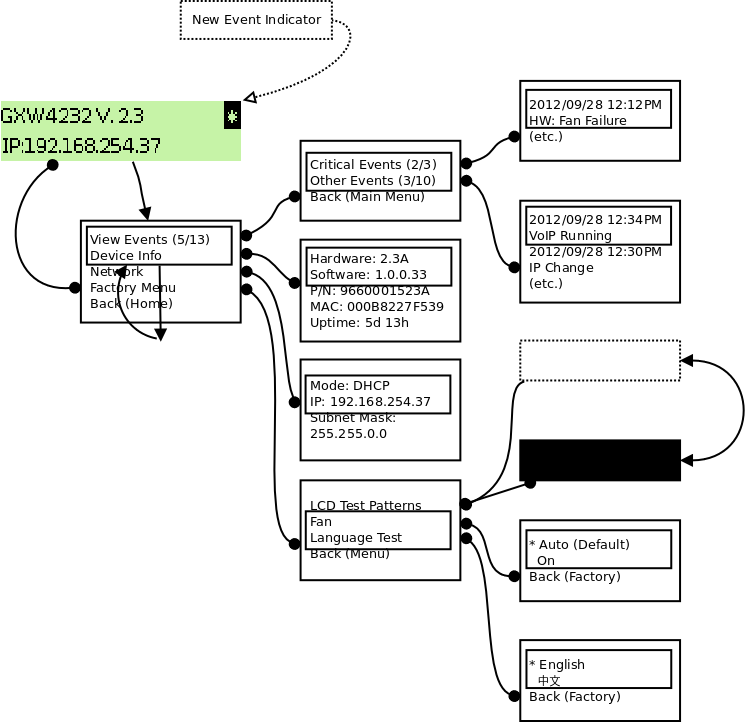
The GXW42XX gateway series includes a small LCD screen for the display of basic information. The LCD has a display area of 128×32 pixels, which will allow for 2 lines of text with a 16px height limitation per line.
The LCD menu is shown in the figure: LCD Menu. The menu is navigated by the Down arrow and the OK button.
BASIC OPERATIONS
Understanding GXW Voice Prompts
GXW42XX has a built-in voice prompt menu for simple device configuration. To enter the voice prompt menu, press *** on the standard analog phone that is connected to the device’s FXS port.
Menu | Voice Prompt | User’s Options |
Main Menu | “Enter a Menu Option” | Enter “*” for the next menu option Enter “#” to return to the main menu Enter “001 – 005,007, 010, 013 – 017,047, 086 or 099” Menu option Enter “9” for confirming an option |
001 | “DHCP Mode”, “PPPoE Mode” or “Static IP Mode” | Enter ‘9’ to toggle the selection
If user selects “Static IP Mode”, user need configure all the IP address information through menu 002 to 005. If user selects “Dynamic IP Mode”, the device will retrieve all IP address information from DHCP server automatically when user reboots the device. |
002 | “IP Address “ + IP address | The current WAN IP address is announced Enter 12-digit new IP address if in Static IP Mode.
|
003 | “Subnet “ + IP address | Same as Menu option 002 |
004 | “Gateway “ + IP address | Same as Menu option 002 |
005 | “DNS Server “ + IP address | Same as Menu option 002 |
007 | Preferred Vocoder | Enter “9” to go to the next selection in the list: PCMU PCMA iLBC G-726 G-723 G-722 G-729 |
010 | “MAC Address” | Announces the Mac address of the unit. |
012 | WAN Port Web Access | Press “9” to switch between enable/disable. |
013 | Firmware Server IP Address | Announces current Firmware Server IP address. Enter 12-digit new IP address. |
014 | Configuration Server IP Address | Announces current Config Server Path IP address. Enter 12-digit new IP address.
|
015 | Upgrade Protocol | Upgrade protocol for firmware and configuration update. Enter “9” to toggle between TFTP HTTP and HTTPS |
016 | Firmware Version | Firmware version information. |
017 | Firmware Upgrade | Firmware upgrade mode. Enter “9” to rotate among the following three options: 1. always check 2. check when pre/suffix changes 3. never upgrade |
020 | “Certification Information” | Annouces the Certification Information of the unit. |
047 | “Direct IP Calling” | Enter the target IP address to make a direct IP call, after dial tone. (See “Make a Direct IP Call”.) |
086 | Voice Mail | Number of voice mails |
099 | “RESET” | Enter “9” to reboot the device; or Enter MAC address to restore factory default setting (See Restore Factory Default Setting section) |
700-748 | Phone calls between different ports of the same GW42xx | GXW42XX support inter-port calling from voice menu for easy test/verification in factory
“700” Ring all ports and connect to first port pick up the call
“701-732” Call individual port |
“Invalid Entry” | Automatically returns to Main Menu |
Five Success Tips when using the Voice Prompt
- “*” shifts down to the next menu option
- “#” returns to the main menu
- “9” functions as the ENTER key in many cases to confirm an option
- All entered digit sequences have known lengths – 2 digits for the menu option and 12 digits for the IP address. For IP address, add 0 before the digits if the digits are less than 3 (i.e., – 192.168.0.26 should be key in like 192168000026. No decimal is needed).
- Key entry cannot be deleted, but the phone may prompt an error once it is detected
Placing a Phone Call
Phone or Extension Numbers
- Dial the number directly and wait for 4 seconds (To change the default value, modify the following setting – “No Key Entry Timeout”)
- Or, you may dial the number directly and press # (Use # as dial key” must be configured in web configuration).
Examples: Dial a number (e.g. (626) 666-7890), first enter the prefix number (usually 1+ or international code) followed by the phone number. Press # or wait for 4 seconds. Check with your VoIP service provider for further details on prefix numbers.
Direct IP Calls
Direct IP calling allows two parties, that is, a FXS Port with an analog phone and another VoIP Device, to talk to each other in an ad hoc fashion without a SIP proxy.
Elements necessary to complete a Direct IP Call:
- Both GXW42XX and other VoIP devices have public IP addresses, or
- Both GXW42XX and other VoIP devices are on the same LAN using private IP addresses, or
- Both GXW42XX and other VoIP devices can be connected through a router using public or private IP addresses (with necessary port forwarding or DMZ).
GXW42XX supports two ways to make Direct IP Calling:
Using IVR
- Pick up the analog phone, then access the voice menu prompt by dialing “***”
- Dial “047” to access the direct IP call menu
- Enter the IP address using the format, ex. 192*168*0*160 after the dial tone.
Using Star Code
- Pick up the analog phone, then dial “*47”
- Enter the target IP address using the same format as above.
Note: NO dial tone will be played between steps 1 and 2.
Destination ports can be specified by using “*” (encoding for “:”) followed by the port number.
Examples:
- If the target IP address is 192.168.0.160, the dialing convention is
*47 or Voice Prompt with option 047, then 192*168*0*160 followed by pressing the “#” key if it is configured as a send key, or wait 4 seconds. In this case, the default destination port 5060 is used if no port is specified.
- If the target IP address/port is 192.168.1.20:5062, then the dialing convention would be:
*47 or Voice Prompt with option 047, then 192*168*0*160*5062 followed by pressing the “#” key if it is configured as a send key or wait for 4 seconds.
Call Hold
Place a call on hold by pressing the “flash” button on the analog phone (if the phone has that button). Press the “flash” button again to release the previously held Caller and resume the conversation. If no “flash” button is available, use “hook flash” (toggle on-off hook quickly). You may drop a call using hook flash.
Call Waiting
Call waiting tone (Repeated short beeps as long as the caller is still calling) indicates an incoming call if the call waiting feature is enabled. Toggle between incoming call and current call by pressing the “flash” button. The first call is placed on hold. Press the “flash” button to toggle between two active calls.
Call Transfer
Blind Transfer
Assume that Caller A and B are in conversation. “A” wants to Blind Transfer “B” to “C”:
- Caller A presses FLASH on the analog phone to hear the dial tone.
- Caller A dials *87, then dials caller C’s number, and then # (or waits for 4 seconds).
- Caller A will hear the confirmation tone. Then, A can hang up.
Caller A can place a call on hold and wait for one of three situations:
- A quick confirmation tone (similar to call waiting tone) followed by a dial tone. This indicates the transfer is successful (the transferee has received a 200 OK from the transfer target). At this point, Caller A can either hang up or make another call.
- A quick busy tone followed by a restored call (on supported platforms only). This means the transferee has received a 4xx response for the INVITE, and we will try to recover the call. The busy tone is just to indicate to the transferor that the transfer has failed.
- Continuous busy tone. The phone has timed out. Note: A continuous busy tone does not indicate the transfer has been successful, nor does it indicate the transfer has failed. It often means there was a failure to receive the second NOTIFY – check firmware for the most recent release.
Attended Transfer
Assume that Caller A and B are in conversation. Caller A wants to Attend Transfer B to C:
- Caller A presses FLASH on the analog phone for dial tone.
- Caller A then dials Caller C’s number followed by # (or wait for 4 seconds).
- If Caller C answers the call, Caller A and Caller C are in conversation. Then A can hang up to complete transfer.
- If Caller C does not answer the call, Caller A can press “flash” to resume call with Caller B.
3-Way Conferencing
The GXW42XX supports Bellcore style 3-way Conference.
Instructions for 3-way conference:
Assuming that call party A and B are in conversation. A (GXW42XX) wants to bring C in a conference:
- A presses FLASH (on the analog phone, or Hook Flash for old model phones) to get a dial tone.
- A dials C’s number then # (or wait for 4 seconds).
- If C answers the call, then A presses FLASH to bring B, C into the conference.
- If C does not answer the call, A can press FLASH back to talk to B.
- If A presses FLASH during the conference, C will be dropped out.
- If A hangs up, the conference will be terminated, or transfer B to C if “Transfer on Conference Hangup” is set to yes
Hunting Group
This feature allows the user to set up a single SIP account on the gateway and have the ability to use all FXS ports to make/receive calls. Using this feature, all ports active in the same Hunting Group will have the same phone number, and incoming calls will be distributed in a Linear or Circular manner among the ports active in that Hunting Group. The number of hunting groups is limited by the number of ports each GXW model has – i.e., each port can be its own Hunting Group. The most practical and efficient way to use Hunting Groups is to assign 2 or 3 ports to separate Hunting Groups.
One additional and popular way to use the Hunting Group feature is called “multiplexed analog lines”. In this configuration, a legacy PBX system with 8 FXO trunks can be connected to 8 GXW42xx ports configured as a Hunting Group. The GXW can be registered to a SIP server provider using only one phone number. If the SIP service provider allows multiple calls to the same number, the GXW will allow 8 concurrent calls to the same SIP number. All office members can be reached remotely using the same phone number in a round-robin fashion.
Example Configuration of a typical Hunting Group:
- Configure the SIP account from your VoIP Service Provider on FXS port 1 under the FXS Ports webpage.
- Select Active under the Hunting Group drop-down for FXS port 1.
- For the remaining ports (say 2, 3, and 4), select 1 for Hunting Group. Ports 2, 3, and 4 are now active members of the hunting group associated with port 1.
This configuration will route all calls directed to FXS port 1 to ports 2, 3, and/or 4 in round robin fashion, respectively, if port 1 is busy or times out. You can configure the ring timeout on the Profile page.
Example configuration of a multiple Hunting Group:
FXS Port #1: SIP UserID and Authenticate ID entered, Hunting Group set to “Active”
FXS Port #2: SIP UserID and Authenticate ID left blank, Hunting Group set to “1”
FXS Port #3: SIP UserID and Authenticate ID left blank, Hunting Group set to “1”
FXS Port #4: SIP UserID and Authenticate ID entered, Hunting Group set to “Active”
FXS Port #5: SIP UserID and Authenticate ID left blank, Hunting Group set to “4”
FXS Port #6: SIP UserID and Authenticate ID left blank, Hunting Group set to “4”
FXS Port #7: SIP UserID and Authenticate ID entered, Hunting Group set to “Active”
FXS Port #8: SIP UserID and Authenticate ID left blank, Hunting Group set to “7”
…
Hunting Group 1 contains ports 1, 2, and 3. Hunting Group 4 contains ports 4, 5, and 6.
Hunting Group 7 contains ports 7, 8.
Please be aware, the choice of 1 for ports 2 and 3, the choice of 4 for ports 5 and 6, and the choice of 7 for port 8 is required to indicate that the SIP account tied to the port marked as “Active” will be used for all members of the same Hunting group. Needless to say, those members of the same Hunting group may not be sequential ports. In the following example, ports 3, 5, and 7 are tied to the SIP Account configured in Port #1 marked as “Active”, and ports 4,6,8 tied to the SIP Account configured in Port #2 marked as “Active” as well.
Example of a non-sequential configuration of a multiple Hunting Group:
FXS Port #1: SIP UserID and Authenticate ID entered, Hunting Group set to “Active”
FXS Port #2: SIP UserID and Authenticate ID entered, Hunting Group set to “Active”
FXS Port #3: SIP UserID and Authenticate ID left blank, Hunting Group set to “1”
FXS Port #4: SIP UserID and Authenticate ID left blank, Hunting Group set to “2”
FXS Port #5: SIP UserID and Authenticate ID left blank, Hunting Group set to “1”
FXS Port #6: SIP UserID and Authenticate ID left blank, Hunting Group set to “2”
FXS Port #7: SIP UserID and Authenticate ID left blank, Hunting Group set to “1”
FXS Port #8: SIP UserID and Authenticate ID left blank, Hunting Group set to “2”
…
FXS Port #24: SIP UserID and Authenticate ID left blank, Hunting Group set to “2”
There are two types of hunting groups, Linear and Circular. Linear style will sort the call to the lowest-numbered available line; this is also called “serial hunting”. Circular style will distribute the calls “round-robin”. If a call is assigned to line 1, the next call goes to 2, and the next to 3. The succession throughout each of the lines continues even if one of the previous lines becomes available. When the end of the hunt group is reached, the hunting starts over at the first line. Lines are skipped if they are still busy on a previous call. These two hunting styles can be configured from the Profile X page.
Inter-Port Calling
In some cases, a user may want to make phone calls between the phones connected to multiple ports of the same gateway when it is used as a standalone unit, without the use of a SIP server. This feature will also be applicable when the gateway is used with Hunting Groups and is registered to a SIP server only with one master number. In such cases, users will still be able to make inter-port calls by using the IVR feature.
For example, on the GXW42XX inter-port, calling is achieved by dialing *** and 7 plus two extra digits corresponding to the port number. For example, the user connected to port 1 can be reached by dialing *** and 701; the user connected to port 24 can be reached by dialing *** 724.
Sending and Receiving Fax
GXW42XX supports fax in two modes: 1) T.38 (Fax over IP) and 2) Fax Pass through. T.38 is the preferred method because it is more reliable and works well in most network conditions. If the service provider supports T.38, please use this method by selecting T.38 as fax mode (default). If the service provider does not support T.38, pass-through mode may be used. If you have problems with sending or receiving faxes, toggle the Fax Tone Detection Mode setting.
CALL FEATURES
GXW42XX supports the traditional telephony features available in a PBX as well as additional advanced telephony features.
Key | Call Features |
*02 | Forcing a Codec (per call): *027110 (PCMU), *027111 (PCMA), *02723 (G723), *02729 (G729), *0272616 (G726-r16), *0272624 (G724-r24), *0272632 (G726-r32), *0272640 (G726-r40), *027201 (iLBC) |
*03 | Disable LEC (pe call) Dial “*03” +” number”. No dial tone is played in the middle. |
*16 | Enable SRTP |
*17 | Disable SRTP |
*30 | Block CallerID (for all-config change) |
*31 | Send CallerID (for all-config change) |
*67 | Block CallerID (per call) |
*82 | Send CallerID (per call) |
*47 | Direct IP Calling. Dial “*47” + “IP address”. No dial tone will be played in the middle. Detail see Direct IP Calling section on page 12. |
*50 | Disable Call Waiting (for all-config change) |
*51 | Enable Call Waiting (for all-config change) |
*69 | Call Return Service: Dial *69 and the phone will dial the last incoming phone number received. |
*70 | Disable Call Waiting (Per Call) |
*71 | Enable Call Waiting (Per Call) |
*72 | Unconditional Call Forward: Dial “*72” and then the forwarding number followed by “#”. Wait for dial tone and hang up. (dial tone indicates successful forward) |
*73 | Cancel Unconditional Call Forward: Dial “*73” and wait for dial tone, then hang up. |
*74 | Enable Paging Call: Dial “*74” and then the destination phone number you want to activate in Paging mode. |
*78 | Enable Do Not Disturb (DND): When enabled all incoming calls will be rejected. |
*79 | Disable Do Not Disturb (DND): When disabled, incoming calls will be accepted. |
*87 | Blind Transfer |
*90 | Busy Call Forward: Dial “*90” and then the forwarding number followed by “#”. Wait for dial tone then hang up. |
*91 | Cancel Busy Call Forward: dial “*91”. Wait for dial tone. Hang up. |
*92 | Delayed Call Forward: Dial “*92” and then the forwarding number followed by “#”. Wait for dial tone then hang up. |
*93 | Cancel Delayed Call Forward: Dial “*93” for a dial tone, then hang up. |
*98 | Play registration ID: Dial “*98”, the registration ID will be announced. |
*99 | Provision start: Dial “*99”, the provisioning process will be triggered. |
Flash/Hook | If user hears call waiting beep, flash/hook will switch to the new incoming call. Also used to switch to a new channel for a new call. |
# | Pressing pound sign will serve as Re-Dial key. |
CONFIGURATION GUIDE
Configuring GXW42XX via Voice Prompt
DHCP Mode
Select voice menu option 001 to enable GXW42XX to use DHCP.
STATIC IP Mode
Select voice menu option 001 to enable GXW42XX to use STATIC IP mode, then use option 002, 003, 004, 005 to set up IP address, Subnet Mask, Gateway, and DNS server respectively.
PPPoE Mode
Select voice menu option 001 to enable GXW42XX to use PPPoE mode.
Firmware Server IP Address
Select voice menu option 013 to configure the IP address of the firmware server.
Configuration Server IP Address
Select voice menu option 014 to configure the IP address of the configuration server.
Upgrade Protocol
Select voice menu option 015 to choose the firmware and configuration upgrade protocol. The user can choose between TFTP, HTTP, and HTTPS.
Firmware Upgrade Mode
Select voice menu option 017 to choose firmware upgrade mode among the following three options:
1) Always check,
2) check when pre/suffix changes,
Configuring GXW42XX with a Web Browser
The GXW42XX series gateway has an embedded Web server that allows users to configure the GXW42XX through a web browser. It has language support for English, Chinese, French, Russian, and Spanish.
Access the Web Configuration Menu
The GXW42XX HTML configuration menu can be accessed via the Ethernet port:
To access the HTML configuration menu from the Ethernet port:
- Follow table 4 to find the Ethernet port IP address.
- Open a web browser, type in the IP address – for example: http://GXW42XX -IP-Address (the GXW42XX IP-Address is the Ethernet IP address for the GXW42XX).
Once the HTTP request is entered and sent from a web browser, the user will see a login screen. There are two default passwords for the login page:
User Level | Username | Password | Web Pages Allowed |
End User Level | user | 123 | Only Status and Basic Settings |
Administrator Level | admin |
| Browse all pages |
Viewer Level | viewer | viewer | View all pages. Not allowed to modify the content. |
Important Settings
The end-user must configure the following settings according to the local environment.
NAT Settings
If you plan to keep the gateway within a private network behind a firewall, we recommend using STUN Server. The following three (3) settings are useful in the STUN Server scenario:
- STUN Server (under Advanced Settings webpage)
Enter a STUN Server IP (or FQDN) that you may have, or look up a free public STUN Server on the internet and enter it in this field. If using Public IP, keep this field blank.
- NAT Traversal (under the Profile web pages)
Set this to Yes when the gateway is behind a firewall on a private network.
DTMF Methods
DTMF Settings are in Profile pages.
- DTMF in-audio
- DTMF via RTP (RFC2833)
- DTMF via SIP INFO
You can enable set priority of DTMF methods according to your preference, from Priority 1 to 3. This setting should be based on your server’s DTMF setting.
Preferred Vocoder (Codec)
The GXW42XX supports a broad range of voice codecs. Under Profile web pages, choose your preferred order of different codecs:
- PCMU/A (or G711µ/a)
- G729
- G723
- G726 (16/24/32/40)
- G722
- iLBC
- AAL2 (all G726)
PAGE DEFINITIONS
This section will describe the options in the Web configuration user interface. As mentioned, a user can log in as an administrator or end-user.
Functions available for the end-user are:
- STATUS: Displays the network status, account status, software version, and MAC address of the phone
- MAINTENANCE: Basic settings such as basic network, date and time settings, and web/SSH access settings can be set here.
- PROFILE – AUDIO SETTINGS: DTMF, Vocoder, and Analog Line settings can be configured here for each port.
Additional functions available to administrators are:
- MAINTENANCE: Full settings for network, upgrade/provisioning, TR-069, Security, and Syslog.
- ADVANCED SETTINGS: To set advanced Ring Tongs, FXO Failover, and System Features.
- PROFILE X: To configure each of the SIP accounts.
- FXS PORTS: To configure each of the FXS ports and Hunting Group,s etc.
Status
System Info | |
Product Model | Displays the product model and hardware version. |
Part Number | Displays the part number. |
Serial Number | Displays the serial number. |
Certificate Type | Displays the security certificate type. |
Software Version |
|
System Up Time | Displays the duration since the device was last rebooted. |
System Time | Displays the current system time synchronized with the configured NTP server. |
System Information | Downloads the system information file for diagnostic purposes. Note: The device supports periodically saving the system time to a local timefile for diagnostic purposes and system continuity. |
Service Status | Displays ATA and GUI service information. |
Network Status | |
MAC Address | Displays the device MAC address in hexadecimal format. The MAC address is used for provisioning and troubleshooting and is printed on the product label and packaging. |
IP Address Mode | Displays the current IP address mode:
|
IP Address | Displays the current IP address assigned to the GXW42xx. |
Subnet Mask | Displays the subnet mask. |
Gateway | Displays the default gateway. |
VPN Link | Displays the VPN connection status. |
PPPoE Link Up | Displays the PPPoE connection status. |
DNS Server 1/2 | Display the primary and secondary DNS server addresses. |
NAT Traversal | Displays the detected NAT type for each SIP profile based on the STUN protocol. |
Port Status | |
Port | Displays the port number. |
Hook | Displays the hook status:
|
SIP Registration | Displays the SIP registration status:
|
Call Features Status | |
Port | Displays the port number. |
DND | Displays whether Do Not Disturb is enabled or disabled. |
Forward | Displays the unconditional call forwarding destination. |
Busy Forward | Displays the call forwarding destination when the line is busy. |
Delayed Forward | Displays the call forwarding destination when the call is not answered. |
CID | Displays whether Caller ID per Call is enabled or disabled. |
Call-Waiting | Displays whether Call Waiting is enabled or disabled. |
SRTP | Displays whether Secure Real-time Transport Protocol is enabled or disabled. |
Maintenance
Network Settings
Network Settings for Service Interface | |
IP Address Mode for Service Interface | Specifies the IP address mode. The available options are:
|
Preferred DNS Server | Specifies the preferred DNS server used when the IP address mode is DHCP or PPPoE. |
DHCP Settings | |
Host name (Option 12) | Specifies the DHCP client host name. This field is optional but may be required by the Internet Service Providers. |
DHCP Domain | Specifies the DHCP domain name. This field is optional but may be required by the Internet Service Providers. |
Vendor Class ID (Option 60) | Specifies the vendor class identifier transmitted in DHCP requests. The default setting is “GXW4200”. |
Client Circuit ID (Option 82) | Used to Encode an Agent-Local identifier of the circuit, Circuit ID sub-option is supposed to include information specific to which circuit the request came in on. |
Remote Agent ID (Option 82) | The relay agent may use this field in addition to or instead of Agent Circuit ID field. The remote ID sub-option carries information relating to the remote host end of the circuit |
PPPoE Settings | |
PPPoE Account ID | Configures the PPPoE account ID. |
PPPoE Password | Configures the PPPoE password. |
PPPoE Service Name | Specifies the PPPoE service name. |
Static IP Settings | |
IP Address | Configures the static IP address. |
Subnet Mask | Configures the subnet mask. |
Gateway | Configures the default gateway. |
DNS Server 1 | Configures the primary DNS server. |
DNS Server 2 | Configures the secondary DNS server. |
Network settings for Management Interface | |
Enable management interface | Enables or disables the management interface for HTTP, HTTPS, and SSH access. If a management VLAN is configured and differs from the service VLAN, the management interface uses the management VLAN. Otherwise, a sub-interface is created on the service interface. |
Management access | Specifies which interface accepts HTTP, HTTPS, and SSH connections. The available options are:
|
Enable SNMP Through Management Interface | Enables or disables routing SNMP traffic through the management interface. |
Enable TR069 Through Management Interface | Enables or disables routing TR-069 traffic through the management interface. Supported on GXW42xx V2 only. |
Enable Syslog Through Management Interface | Enables or disables routing Syslog traffic through the management interface. Disabled by default. Supported on GXW42xx V2 only. |
Enable Radius Through Management Interface | Enable or disable routing the web access radius packets through management interface Supported on GXW42xx V2 only. |
IP Address Mode for Management Interface | Specifies the IP address mode for the management interface. The available options are:
|
Static IP Settings (Management Interface) | |
IP Address | Specifies the static IP address for the management interface. The default setting is “192.168.100.100”. |
Subnet Mask | Specifies the subnet mask for the management interface. |
Gateway | Specifies the default gateway for the management interface. |
DNS Server 1 | Specifies the primary DNS server for the management interface. |
DNS Server 2 | Specifies the secondary DNS server for the management interface. |
LLDP | |
Enable LLDP | Enables or disables Link Layer Discovery Protocol (LLDP). |
Layer 2 QoS Settings | |
Layer 2 QoS 802.1Q/VLAN Tag for Service Interface | Specifies the layer 2 QoS 802.1Q/VLAN Tag for the service interface. The default setting is “0”. The valid range is 0-4095. |
Layer 2 QoS 802.1Q/VLAN Tag for Management Interface | Specifies the layer 2 QoS 802.1Q/VLAN Tag for the management interface. The default setting is “0”. The valid range is 0-4095. |
Layer 2 QoS 802.1p Priority Value for SIP signaling | Specifies the Layer 2 QoS 802.1p priority for SIP signaling packets. |
Layer 2 QoS 802.1p Priority Value for RTP media | Specifies the Layer 2 QoS 802.1p priority for RTP media packets. |
Layer 2 QoS 802.1p Priority Value for Management Interface | Specifies the Layer 2 QoS 802.1p priority for management interface traffic. |
Advanced Network Settings | |
Maximum Transmission Unit (MTU) | Configures the Maximum Transmission Unit (MTU) in bytes. The MTU specifies the largest IP packet size that can be transmitted without fragmentation. The default setting is “1500”. The valid range is 576 to 1500 bytes. |
HTTP Proxy | Specifies the HTTP proxy URL used by the gateway to route packets. The proxy server acts as an intermediary between the gateway and the destination. |
HTTPS Proxy | Specifies the HTTPS proxy URL used by the gateway to route packets. The proxy server acts as an intermediary between the gateway and the destination. |
Bypass Proxy for | Specifies the destination IP addresses that do not require a proxy server. The gateway sends packets directly to the specified destinations without using the proxy server. |
STUN Settings | |
Use STUN | Enables or disables STUN. Disabled by default. |
STUN server | Specifies the IP address or domain name of the STUN server. Only non-symmetric NAT routers work with STUN. |
Number of STUN Response Misses Allowed | The Number of STUN response misses allowed before restarting DHCP. The minimum is 3 misses. Specifies the number of consecutive STUN response timeouts allowed before DHCP is restarted. The default setting is “3”. the valid range is 3-15. |
Keep-Alive Interval | Specifies the interval, in seconds, at which the device sends a UDP keep-alive packet to maintain the NAT binding. |
Firewall Setting | |
Blocklist for WAN Side Port | Specifies the WAN-side ports or port ranges to block. Multiple entries can be separated by commas. Example: 5000-6000,7000 |
Reply to ICMP | Enables or disables responses to ICMP echo requests on the WAN side port. |
Local DNS Setting | |
Local DNS | Specifies local DNS mappings between fully qualified domain names (FQDNs) and IP addresses. |
Upgrade and Provisioning
Lock Keypad Update | If set to “Yes”, the configuration update via keypad is disabled. |
Firmware Upgrade and Provisioning | Specifies how firmware upgrading and provisioning request to be sent. There are three options to choose from: “Always Check for New Firmware”, “Check New Firmware only when F/W pre/suffix changes”, and “Always Skip the Firmware Check”. |
XML Config File Password | The password used for encrypting the XML configuration file using Open SSL. This is required for the phone to decrypt the encrypted XML configuration file. |
HTTP/HTTPS User Name | The user name needed to authenticate with the HTTP/HTTPS server. |
HTTP/HTTPS Password | The password needed to authenticate with the HTTP/HTTPS server. |
Always send HTTP Basic Authentication Information | Default is No. If set to Yes, device will send configured user name and password within HTTP request before server sends authentication challenge. |
Validate Hostname in Certificate | This option controls whether the device should verify the server hostname against the Common Name (CN) or Subject Alternative Name (SAN) fields in the SSL certificate during HTTPS or FTPS provisioning and upgrade.
|
Upgrade via | Allows users to choose the firmware upgrade method via TFTP, HTTP or HTTPS. |
Firmware Server Path | IP address or domain name of firmware server. That URL of the server that hosts the firmware release. The default server is: fm.grandstream.com/gs Note: Valid input needs to match the following values ^$|^[a-zA-Z_.0-9-]{1,253}$|^[a-zA-Z_.0-9-]{1,253}/[a-zA-Z~%+_= ./0-9-]*$|^[a-zA-Z_.0-9-]{1,253}:[0-9]{1,5}$|^[a-zA-Z_.0-9-]{1,253}:[0-9]{1,5}/[a-zA-Z~%+_= ./0-9-]*$|^[[0-9a-f]{1,4}:[0-9a-f]{1,4}:[0-9a-f]{1,4}:[0-9a-f]{1,4}:[0-9a-f]{1,4}:[0-9a-f]{1,4}:[0-9a-f]{1,4}:[0-9a-f]{1,4}]$|^[[0-9a-f]{1,4}:[0-9a-f]{1,4}:[0-9a-f]{1,4}:[0-9a-f]{1,4}:[0-9a-f]{1,4}:[0-9a-f]{1,4}:[0-9a-f]{1,4}:[0-9a-f]{1,4}]/[a-zA-Z~%+_= ./0-9-]*$|^[[0-9a-f]{1,4}:[0-9a-f]{1,4}:[0-9a-f]{1,4}:[0-9a-f]{1,4}:[0-9a-f]{1,4}:[0-9a-f]{1,4}:[0-9a-f]{1,4}:[0-9a-f]{1,4}]:[0-9]{1,5}$|^[[0-9a-f]{1,4}:[0-9a-f]{1,4}:[0-9a-f]{1,4}:[0-9a-f]{1,4}:[0-9a-f]{1,4}:[0-9a-f]{1,4}:[0-9a-f]{1,4}:[0-9a-f]{1,4}]:[0-9]{1,5}/[a-zA-Z~%+_= ./0-9-]*$ |
Config Server Path | IP address or domain name of the configuration server. The server hosts a copy of the configuration file to be installed on the gateway. The default server is: fm.grandstream.com/gs
Note: Valid input needs to match ^$|^[a-zA-Z_.0-9-]{1,253}$|^[a-zA-Z_.0-9-]{1,253}/[a-zA-Z~%+_= ./0-9-]*$|^[a-zA-Z_.0-9-]{1,253}:[0-9]{1,5}$|^[a-zA-Z_.0-9-]{1,253}:[0-9]{1,5}/[a-zA-Z~%+_= ./0-9-]*$|^[[0-9a-f]{1,4}:[0-9a-f]{1,4}:[0-9a-f]{1,4}:[0-9a-f]{1,4}:[0-9a-f]{1,4}:[0-9a-f]{1,4}:[0-9a-f]{1,4}:[0-9a-f]{1,4}]$|^[[0-9a-f]{1,4}:[0-9a-f]{1,4}:[0-9a-f]{1,4}:[0-9a-f]{1,4}:[0-9a-f]{1,4}:[0-9a-f]{1,4}:[0-9a-f]{1,4}:[0-9a-f]{1,4}]/[a-zA-Z~%+_= ./0-9-]*$|^[[0-9a-f]{1,4}:[0-9a-f]{1,4}:[0-9a-f]{1,4}:[0-9a-f]{1,4}:[0-9a-f]{1,4}:[0-9a-f]{1,4}:[0-9a-f]{1,4}:[0-9a-f]{1,4}]:[0-9]{1,5}$|^[[0-9a-f]{1,4}:[0-9a-f]{1,4}:[0-9a-f]{1,4}:[0-9a-f]{1,4}:[0-9a-f]{1,4}:[0-9a-f]{1,4}:[0-9a-f]{1,4}:[0-9a-f]{1,4}]:[0-9]{1,5}/[a-zA-Z~%+_= ./0-9-]*$ |
Firmware File Prefix | This field enables user to store different versions of firmware files in one single directory on the firmware server. If configured, only the firmware file with the matching prefix will be downloaded. |
Firmware File Postfix | This field enables user to store different versions of firmware files in one single directory on the firmware server. If configured, only the firmware file with the matching postfix will be downloaded. |
Config File Prefix | This field enables user to store different configuration files in one single directory on the configuration server. If configured, only the configuration file with the matching prefix will be downloaded. |
Config File Postfix | This field enables user to store different configuration files in one single directory on the configuration server. If configured, only the configuration file with the matching postfix will be downloaded. |
Allow DHCP Option 43 and Option 66 to Override Server | If set to “Yes”, configuration and upgrade server’s information can be obtained using DHCP option 66 from DHCP server. This option specifies the URL of the TFTP server. Notes:
|
Enable Using tags in URL | Allows users to configure variables on the configuration server path to differentiate the directories on the server. Example: When provisioning, a user can define the mac address and IP address when sending the HTTP Send request link in the following form “192.168.5.96:8060/?mac=[MAC]&lan_ip=[IP]”, the link will look like this example:http://192.168.5.99/mac=000b89a9064&lan_ip=192.168.5.99/cfg.xml Default Value is “No”. |
Download and Process All Available Config Files | By default, the device first provisions cfgMAC, then attempts to provision the first available configuration file in the following order: DHCP Option 67 boot file (cfgdhcpopt67.xml) → cfgMAC.xml → cfgProductModel.xml → cfg.xml (corresponding to the Option 67-specific, device-specific, model-specific, and global configuration files). When this option is enabled, the device downloads and processes all available configuration files in the following order: cfg.xml → cfgProductModel.xml → cfgMAC.xml → cfgMAC → cfgMAC_override.xml → DHCP Option 67 boot file (cfgdhcpopt67.xml). Each configuration file is applied sequentially, and settings in later configuration files overwrite those applied by previously processed configuration files. |
Provision Config Order | Configures the custom order in which the device provisions configuration files when Download and Process All Available Config Files is disabled. Select configuration files from the Available list and use the right arrow button to move them to the Selected list. To remove a configuration file from the Selected list, use the left arrow button to move it back to the Available list. Use the up and down arrow buttons to arrange the configuration files in the Selected list in the desired provisioning order.
By default, the Selected list contains the following configuration files in this order: |
Additional Override DHCP Option | Allow users to configure additional DHCP Options to be used for the firmware server instead of the configured firmware server or the server from DHCP Options 43 and 66. It can be set to None or Option 150, it is set to None by default. |
3CX Auto Provision | Default is No. If set to Yes, phone will multicast SUBSCRIBE for provision if this feature is enabled. |
Automatic Upgrade | Choose “Yes” to enable automatic upgrade and provisioning. When set to No, GXW42XX will only do upgrade once at boot up. When “Check every day” or “Check every week” is checked, user can specify “Hour of the day (0-23)” or “Day of the week (0-6)”. Default time is Monday 1AM. |
Randomized Automatic Upgrade | With this feature enabled, device will specify a random time to upgrade the device within the range of hours of the day or postpone the upgrade every X minute(s) by random 1 to X minute(s) |
Hour of the Day (0-23) | Define the hour of the day to check HTTP/TFTP server for firmware upgrades or configuration files changes |
Day of the Week (0-6) | Define the days of the week to check HTTP/TFTP server for firmware upgrades or configuration files changes |
Authenticate Conf File | If set to Yes, configuration file is authenticated before being accepted. This protects the configuration from unauthorized modifications. |
Firmware Key | For firmware encryption. It should be 32-digit in Hexadecimal Representation. End user should keep it blank. |
Configuration File Types Allowed | Allow users to choose Allowed Configuration File Types, All or XML Only, and Set by default to All. |
Provision | Allows the user to manually provision the device based on the provided firmware path, without the need to reboot the unit. |
Upload Device Configuration | |
Upload Device Configuration | Upload the Config file to reload settings. |
Restore from Backup Configuration | Restore the device configuration from the backup file. |
Upload Device Firmware | |
Upload Device Firmware | Upload .bin file to the device to upgrade the firmware. |
Download Device Configuration | |
Device Configuration (Text format) | Click to download the device configuration file in .txt format. |
Device Configuration (XML format) | Click to download the device configuration file in .xml format. |
Export Backup Configuration (Encrypted XML) | Click to export all device configurations in encrypted .xml format |
Web and SSH Access
HTTP Web Port | Configures the HTTP port. This field is for customizing the web port. The default setting is “80”. |
HTTPS Web Port | Configures the HTTPS port. This field is for customizing the web port. The default setting is “443”. |
Web Access Mode | Specifies Web Access Protocol. The available options are:
The default setting is “HTTPS”. |
Disable SSH | Disables SSH access. The default setting is “No”. |
SSH Port | Configures the SSH access port number. The default setting is “22”. |
Security Controls for SSH Access | Allow users to configure security privileges. The security privilege options can be as follows :
The default setting is: “Allow all SSH users to set any Pvalue” |
Enable Web/SSH Access | Selects how web/SSH service can be accessed. The available options are:
The default setting is “Yes”. |
Web Session Timeout | Specifies the idle time in minutes before the web session is logged out. The default setting is “10” minutes. The valid range is 1-60 minutes. |
Web Access Attempt Limit | Specifies the maximum number of failed login attempts before the web access is locked out. The default setting is “5”. The valid range is 1-10. |
Lockout Time Interval | Specifies the lockout duration after the number of failed login attempts configured in Web Access Attempt Limit is reached. The default setting is “15” minutes. The valid range is 1-15 minutes. |
Disable User Level Web Access | Disables User-level access to the web UI. The default setting is “Yes”. |
Disable Viewer Level Web Access | Disables Viewer-level access to the web UI. The default setting is “Yes”. |
Viewer Password | |
New Password | Sets new password for Web GUI access as Viewer. This field is case sensitive with a maximum length of 30 characters. |
Confirm Password | Confirms the new password entered in the New Password field. |
User Password | |
New Password | Sets new password for Web GUI access as User. This field is case sensitive with a maximum length of 30 characters. |
Confirm Password | Confirms the new password entered in the New Password field. |
Admin Password | |
New Password | Sets new password for Web GUI access as Admin.
|
Confirm Password | Confirms the new password entered in the New Password field. |
Strict Password Rules | |
Enable strict password rules | Enables or disables strict password rules, including the required password length, number of character classes, and allowed character classes. The default setting is “Yes”. |
Minimum password length | Specifies the minimum password length. The default setting is “8”. |
Required character classes | Specifies the number of character classes required in the password. The default setting is “3”. |
Allowed Character classes | Specifies the character classes allowed in the password. The default setting is “Lower case, upper case, numbers”. |
Access Control Lists | |
White list for WAN side | Specifies the IP addresses allowed to access the Web GUI and SSH from the WAN side. Multiple IP addresses are supported and must be separated by spaces. Example: 192.168.5.222 192.168.5.223 192.168.7.0/24 |
Block list for WAN side | Specifies the IP addresses blocked from accessing the Web GUI and SSH from the WAN side. Multiple IP addresses are supported and must be separated by spaces. Example: 192.168.5.222 192.168.5.223 192.168.7.0/24 |
TR-069
Enable TR-069 | Enables or disables TR-069 service. Enabled by default. Notes:
|
ACS URL | Configures the TR-069 Auto Configuration Server. (e.g., http://acs.mycompany.com, or IP address). |
ACS Username | Specifies the ACS Username for TR-069. |
ACS Password | Specifies the ACS Password for TR-069. |
Periodic Inform Enable | Enables or disables periodically sending Inform messages to the TR-069 Auto Configuration Server. The default setting is “No”. |
Periodic Inform Interval | Specifies the interval for sending Inform messages to the TR-069 Auto Configuration Server. The default setting is “300”. |
Connection Request Username | Specifies the username used by the TR-069 Auto Configuration Server to connect to the device. |
Connection Request Password | Specifies the password used by the TR-069 Auto Configuration Server to connect to the device. |
Connection Request Port | Specifies the port used by the TR-069 Auto Configuration Server to connect to the device. The default setting is “7547”. |
CPE SSL Certificate | Specifies the CA certificate used to authenticate the TR-069 Auto Configuration Server’s TLS certificate. |
CPE SSL Private Key | Specifies the private key for the CPE SSL certificate. The maximum length is 2048 characters. |
SNMP
Enable SNMP | Enables or Disables the SNMP feature. The default setting is "No". |
SNMP Version | Selects the version of SNMP Agent. The available options are:
The default setting is "Version 3". |
SNMP Port | Configures the listening port of SNMP Daemon. The default setting is "161". |
SNMP Trap IP Address | Specifies the IP address of the SNMP trap receiver. Up to 3 different servers can be configured to receive SNMP traps. Separate the trap server addresses with commas. |
SNMP Trap Port | Configures the port of the SNMP trap receiver The default setting is "162". |
SNMP Trap Version | Selects the version of SNMP Trap. The available options are:
The default setting is "Version 2c". |
SNMP Trap Interval | Specifies the interval between each trap sent to the trap receiver. The default setting is "5". |
SNMPv1/v2c Community | Specifies the SNMPv1/v2c community name. |
SNMPv1/v2c Trap Community | Specifies the SNMPv1/v2c trap community name. It must match the community string configured on the trap receiver. |
SNMPv3 User Name | Specifies the username for the SNMPv3 user. |
SNMPv3 Security Level | Selects the security level for the SNMPv3 user. The available options are:
The default setting is "noAuthUser". |
SNMPv3 Authentication Protocol | Selects the authentication protocol for the SNMPv3 user. The available options are:
The default setting is "None". |
SNMPv3 Privacy Protocol | Selects the privacy protocol for the SNMPv3 user. The available options are:
The default setting is "None". |
SNMPv3 Authentication Key | Configures the authentication key for the SNMPv3 user. |
SNMPv3 Privacy Key | Configures the privacy key for the SNMPv3 user. |
SNMPv3 Trap User Name | Specifies the username for the SNMPv3 trap user. |
SNMPv3 Trap Security Level | Selects the security level for the SNMPv3 trap user. The available options are:
The default setting is "noAuthUser". |
SNMPv3 Trap Authentication Protocol | Selects the authentication protocol for the SNMPv3 trap user. The available options are:
The default setting is "None". |
SNMPv3 Trap Privacy Protocol | Selects the privacy protocol for the SNMPv3 trap user. The available options are:
The default setting is "None". |
SNMPv3 Trap Authentication Key | Configures the authentication key for the SNMPv3 trap user. |
SNMPv3 Trap Privacy Key | Configures the privacy key for the SNMPv3 trap user. |
Download MIB | Downloads the MIB file. |
RADIUS
RADIUS for Web Access Authentication | |
Enable RADIUS Web Access Control | Default is No |
Action upon RADIUS Auth Server Error | Choose action upon RADIUS server error. Default is Authenticate Locally |
RADIUS Auth Protocol | Configure RADIUS authentication protocol, the available options are: PAP (Password Authentication Protocol): PAP sends the username and password in plaintext, making it less secure than other methods. |
RADIUS Auth Server Address | Address of RADIUS Auth server |
RADIUS Auth Server Port | Port of RADIUS Auth server (Default 1812) |
RADIUS Shared Secret | Set RADIUS shared secret |
RADIUS VSA Vendor ID | Configure RADIUS VSA Vendor IS to match RADIUS server’s configuration. Default is 42397 for Grandstream Networks Inc |
RADIUS VSA Access Level Attribute | Configure RADIUS VSA Access Level Attribute to match RADIUS server’s configuration. Note: Incorrect setting would cause RADIUS authenticate fail |
RADIUS for call | |
Primary RADIUS Server | Set Primary RADIUS Server address. |
Primary RADIUS Authentication Port | Default is 1812. |
Primary RADIUS Account Port | Default is 1813. |
Primary RADIUS Server Secret | Set Primary RADIUS Server Secret |
Secondary RADIUS Server | Set Secondary RADIUS Server address. |
Secondary RADIUS Authentication Port | Default is 1812. |
Secondary RADIUS Account Port | Default is 1813. |
Secondary RADIUS Sever Secret | Set Secondary RADIUS Server Secret |
RADIUS Timeout | Default is 2. |
RADIUS Retry | Default is 3. |
DDNS
Enable DDNS | Default value is No |
DDNS Server | Configure the DDNS server, this can be set to the following values :
The default value is dyndns.org |
DDNS Username | Configure the username of DDNS server |
DDNS Password | Configure the password of DDNS server |
DDNS Hostname | Configure the hostname of DDNS server |
DDNS Hash | Configure the hash of DDNS server |
802.1x
802.1X Mode | Enable and disable the 802.1X feature and also set to the appropriate mode :
The default value is Disable |
802.1X Identity | Enter the Identity for the 802.1X mode. |
MD5 Password | Enter the MD5 Password for 802.1X mode. |
802.1X CA Certificate | Upload or Delete the EAP-PEAPv0/MSCHAPv2, EAP-TLS, .pem file. |
802.1X Client Certificate | Upload or Delete the EAP-TLS, .pem file with both certificate and private key. |
VPN
OpenVPN® Settings | |
OpenVPN Enable | Enables or disables the OpenVPN® feature. The default setting is “No”. |
OpenVPN® Server Address | Specifies the IP address or FQDN of the OpenVPN® server. |
OpenVPN® Port | Specifies the port used by the OpenVPN® server. The default setting is “1194”. |
OpenVPN® Server Secondary Address | Specifies the IP address or FQDN of the secondary OpenVPN® server. |
OpenVPN® Secondary Port | Specifies the port used by the secondary OpenVPN® server. The default setting is “1194”. |
Randomly Select Server | Enables or disables random server selection. The available options are:
The default setting is “No”. |
Interface type | Specifies whether the interface type is Bridge (TAP) or Router (TUN). The default setting is “TUN”. |
OpenVPN® Transport | Specifies whether the OpenVPN® transport type is UDP or TCP. |
Enable LZO Compression | Enables or disables LZO compression for the VPN connection. The default setting is “Yes”. Note: Enable this option only if LZO compression is also enabled on the OpenVPN® server. |
OpenVPN® Encryption | Specifies the encryption algorithm used for OpenVPN®. The available options are:
The default setting is “BF-CBC 128 bit default key (variable) Default”. |
OpenVPN® Digest | Specifies the digest algorithm used for OpenVPN®. The default setting is “SHA1”. |
OpenVPN® Username | Specifies the username used for OpenVPN® authentication. This field is optional and the maximum length is 32 characters. |
OpenVPN® Password | Specifies the password used for OpenVPN® authentication. This field is optional and the maximum length is 32 characters. |
OpenVPN® CA |
Note: Expects a ca.crt file. |
OpenVPN® Certificate |
Note: Expects a client.crt file. |
OpenVPN® Client Key |
Note: Expects a client.key file. |
OpenVPN® Client Key Password | Specifies the password used to decrypt the OpenVPN® Client Key. |
OpenVPN® TLS Key | Expects a .key file. Maximum length is 8192 characters.
Note: The TLS key is used for HMAC authentication or encryption of the control channel, depending on the selected OpenVPN® TLS Key Type. |
OpenVPN® TLS Key Type | Selects the encryption type of the OpenVPN® TLS key. The available options are:
The default setting is “None”. |
OpenVPN® Additional Options | Specifies additional OpenVPN® options to append to the OpenVPN® configuration file. Note: Additional options must be separated by semicolons. Example: connect-retry 5;tls-client;keepalive 10 60 Caution: Ensure that the specified options are supported by OpenVPN® and do not override other configurations. |
Security Settings
Security
SIP TLS Certificate | The GXW42XX series supports SIP over TLS. It has built-in private key and SSL certificate. The user specified SSL certificate used for SIP over TLS is in X.509 format. |
SIP TLS Private Key | You may also customize the SIP TLS Private Key. The user specified SIP TLS private key used for SIP over TLS is in X.509 format. |
SIP TLS Private Key Password | SSL Private key password used for SIP Transport in TLS/TCP. |
Custom Certificate | This feature allows users to upload to this device their own certificate signed by custom CA certificate to manage client authentication. |
Validate Server Certificates | This feature allows users to validate server certificate with our trusted list of TLS connections. The device needs to reboot after changing the setting. Default value is No. |
Keep Security Setting After Reset | This feature depends on the reset lock feature. If enabled, security-related settings and trusted CA-related |
Disable Weak TLS Cipher Suites | This feature allows users to Enable or Disable Weak TLS Cipher Suites.
Note: The default option is Disable All Of The Above Weak TLS Ciphers Suites. |
Minimums TLS Version | Configures the minimum TLS version supported by the phone.
Note: The default setting is TLS 1.2. |
Maximum TLS Version | Configures the maximum TLS version supported by the phone. Default is Unlimited. Note: The default setting is Unlimited. |
Trusted CA
Trusted CA Certificate (A, B, C, D) | Configures the Trusted CA Certificate(s). The certificate entered here is used as a trusted CA to authenticate the server's TLS certificate. |
Load CA Certificates | This feature specifies which CA Certificates the gateway needs to trust. Following options are available:
The default setting is “Built-in Trusted Certificates”. |
Date and Time
NTP Server | URI or IP address of the NTP (Network Time Protocol) server. Used by the phone to synchronize the date and time. An extensive list of public NTP servers can be found at http://www.ntp.org |
Secondary NTP server | URL or IP address of the secondary NTP server. The gateway may obtain the date and time from this server. |
NTP Update Interval | Defines the update interval (in minutes) to obtain the date and time from the server. |
Allow DHCP Option 42 to NTP Server | Default is Yes. DHCP Option 42 is enabled, the NTP server can be changed. If set to No will disable the NTP server be changed. |
Time Zone | Configures the system’s local date and time based on the selected time zone. The device automatically adjusts for daylight saving time (DST) where applicable, ensuring accurate timekeeping across regions that observe seasonal time changes. Recent updates have expanded the list of supported zones to improve alignment with regional DST rules, including locations in the Middle East. |
Self-Defined Time Zone | This parameter allows the users to define their own time zone. For syntax and examples, please refer to user manual. |
Allow DHCP Option 2 to override time zone | Default is Yes. DHCP Option 2 is enabled, the time zone can be offset. If set to No, it will disable the time zone be offset. |
Local Time | Allows users to set the device time from the host PC time via the browser. After clicking the button “Sync PC”, a pop-up window will inform the user that the synchronization has been done successfully. |
Syslog
Syslog Protocol | Selects the protocol used to send syslog messages. The available options are:
The default setting is “UDP”. |
Syslog Server | Specifies the IP address or URL of the syslog server that collects system log information from the device. Note: To retain syslog settings and internal logs after a factory reset, enable P-value P82307 in the device configuration file. The available values are 0 (No) and 1 (Yes). The default setting is 0 (No). |
Syslog Level | Selects the syslog level reported by the gateway. The available options are:
The default setting is “None. Syslog messages are sent based on the following events:
The Syslog uses USER facility. In addition to standard Syslog payload, it contains the following components: GS_LOG: [device MAC address][error code] error message Example: May 19 02:40:38 192.168.1.14 GS_LOG: [00:0b:82:00:a1:be][000] Ethernet link is up |
Syslog Header Format | Selects the Syslog Header Format, When set to “RFC3164-compliant”, the syslog header will contain the PRI and timestamp information to be compatible with RFC3164. The default setting is “Default”. |
Print SIP in Syslog | Enable or disable printing of full SIP messages in Syslog. The default setting is “No”. |
SIP Log Option | Selects how SIP log files are handled when the allocated storage is full. By default, the device divides the allocated SIP log storage into two files of equal size. When the first file is full, the device creates the second file. The available options are:
The default setting is “Overwrite”. |
Save Syslog | Saves syslog messages to the device. The device stores syslog messages in three rotating files, each with a maximum size of 3 MB. Note: Scroll down to Syslog List and The List for SIP Log Files to download the saved logs. |
The List for SIP log Files | |
Download | Downloads the SIP log file as a .log file. |
Delete | Deletes the SIP log file. |
Preview | |
Call Record
CDR record option | Selects how the device handles CDR records when the allocated storage is full. By default, the device divides the allocated CDR storage into two files of equal size. The device creates the first file and, when it is full, creates the second file. The available options are:
The default setting is "Overwrite". |
Download | Downloads the CDR records as a .csv file. |
Delete | Deletes the CDR records. |
Preview | Redirects to Preview Call Record, which displays the following call record information:
|
Port Record
Port | Specifies the port ID for port recording. The valid range is 1 to the maximum port ID. |
Status | Displays the port recording status, indicating whether recording is stopped or in progress. For example: No port is recording or Port 1 is recording now. |
The List for Port Record pcm Files | |
Download | Downloads the captured .tgz file. |
Start | Starts recording on the configured port. |
Stop | Stops recording on the configured port. |
Ethernet Capture
With Secret Key information | Enables or disables the inclusion of secret key information in the packet capture file. The default setting is "Yes". |
Status | Displays the Ethernet packet capture status: Stopped or Running. |
The List for Ethernet pcap Files | |
Download | Downloads the captured .tgz file. |
Delete | Deletes the captured file. |
Start | Starts the Ethernet packet capture. |
Stop | Stops the Ethernet packet capture. |
Advanced Settings
Ring Tones | |
System Ring Cadence | Configures the ring cadence for incoming calls on all FXS ports. (Syntax: c=on1/off1-on2/off2-on3/off3; […]) The default setting is “c=2000/4000;” (US standards) |
Call Progress Tones | Configures the tone frequencies according to user preference. By default, the tones are set to North American frequencies. Frequencies should be configured with known values to avoid uncomfortable high pitch sounds. ON is the period of ringing (ON time in ms) while OFF is the period of silence. In order to set a continuous ring, OFF should be zero. Otherwise, it will ring ON ms and a pause of OFF ms and then repeat the pattern. The below tones can be configured with the following syntax :
Please refer to the document below to determine your local call progress tones: |
FXO Failover | |
Failover to FXO Gateway | Enable or disable the Failover FXO Gateway. The default setting is “Disabled”. |
FXO Gateway IP | Configures the IP Address or URI of the FXO gateway. |
System Features | |
Disable Direct IP Call | Disables or enables the Direct IP Call function. When set to “Yes”, direct IP-to-IP calling is not supported. The default setting is “No”. |
Inter-port Calling | Enables or disables inter-port calling. When enabled, an unregistered FXS port can use its extension for inter-port dialing instead of ***7xx. Calls between unregistered ports do not route the INVITE to the SIP server. The default setting is “Disabled”. |
Enable SIP NOTIFY Authentication | Enables or disables authentication challenges for SIP NOTIFY reboot and resync messages. The default setting is “Yes”. |
Disable Voice Prompt | Disables or enables the voice prompt configuration. When set to “Yes”, the integrated voice menu is inaccessible. The default setting is “No”. |
IVR Language | Selects the IVR Language. The supported languages are:
The default setting is “English”. |
Upload/Delete Language Pack |
|
LCD Display Language | Selects the LCD display language. The supported languages are:
The default setting is “English”. |
Prompt Dial Tone Code | Configures the prompt dial tone code to simulate an analog PBX where a code is required to dial an outside line. |
Port Lock Code | Specifies the port lock code used with the star code to lock or unlock a specific port for outbound calls. The default setting is “21”. The default is *21. The user is required to press *21 and the four-digit locking code twice to set the lock code.
|
Play Busy Tone When Account is unregistered | Enables or disables playing the busy tone when a user goes offhook from an unregistered account. The default setting is “No”. |
Hunting Group Registration Mode | Select the hunting group registration mode. The available options are:
The default setting is “Active Port Only”. |
Country Specific Deployment | Selects the tones to match the country’s specifications. The available options are:
|
Automatic Reboot | Selects the automatic reboot schedule. When a reboot schedule is selected, specify the corresponding schedule time options. The available options are:
The default setting is “No”. |
Hour of the Day (0-23) | Defines the hour of the day to reboot the gateway. |
Day of the Week (0-6) | Defines the day of the week to reboot the gateway. |
Day of the Month (1-31) | Defines the day of the month to reboot the gateway. |
Reset Type | Selects the type of reset to perform via the Preform Selected Reset button. The available options are:
The default setting is “Full Reset”. |
Perform Selected Reset | Performs the selected reset type in Reset Type. |
LED Pattern | Selects the LED pattern. The available options are:
The default setting is “Pattern A”. |
Static DNS | |
A Record Settings | |
Name | Configures the domain name to which the record refers. The maximum supported length is 256 characters. |
TTL | Configures the Time to Live, which is the time interval that the record may be cached before the source of the information should be consulted again. The default setting is “300”. The valid range is from 300 to 65535. |
Address | Configures theIP address associated with the domain. The maximum supported length is 64 characters. |
SRV Settings | |
Name | Configures the domain name to which the record refers.The maximum supported length is 256 characters. Notes: When a SIP server returns a 5XX response, the device can automatically switch to an available backup IP address obtained through DNS SRV
|
TTL | Configures the Time to Live, which is the time interval that the record may be cached before the source of the information should be consulted again. The default setting is “300”. The valid range is from 300 to 65535. |
Priority | Specifies the priority of target hosts that provide the service. Lower values indicate higher priority. Target hosts with the same priority are selected according to the Weight setting. The default setting is “0”. The valid range is from 0 to 65535. |
Weight | Specifies the weight for entries with the same priority. Larger weight will get higher priority. The default setting is “0”. The valid range is from 0 to 65535. |
Port | Specifies the port on the target host of the specified service. The default setting is “0”. The valid range is from 0 to 65535. |
Target | Configures the domain name of the target host. The maximum supported length is 64 characters. |
NAPTR Settings | |
Name | Configures the domain name to which this resource record refers. The maximum supported length is 256 characters. |
TTL | Configures the Time to Live, which is the time interval that the record may be cached before the source of the information should be consulted again. The default setting is “300”. The valid range is from 300 to 65535. |
Order | Specifies the order in which NAPTR records are processed. Lower values are processed before higher values. The default setting is “0”. The valid range is from 0 to 65535. |
Preference | Specifies the preference for processing NAPTR records with the same Order value. Lower values are processed before higher values. The default setting is “0”. The valid range is from 0 to 65535. |
Flags | Specifies the action to perform after the NAPTR lookup. The available flags are:
|
Service | Specifies the services available in this domain. The Replacement field is used to locate the specified service. The maximum length is 64 characters. It can also specify the protocol used to communicate with the server that offers the service. In SIP, the following services are defined along with their resolution services (the resolution services are defined after the + sign):
The default setting is “SIP+D2U”. |
Regexp | Configures a substitution expression that is applied to the original string held by the client to construct the next domain name to look up. |
Replacement | Specifies the next FQDN to query for NAPTR, SRV, or address records, depending on the Flags value. |
Profiles
General Settings | |
Profile Active | Enables or disables the SIP profile. |
SIP Server | Specifies the IP address or domain name of the SIP server provided by the VoIP service provider. |
Failover SIP Server | Specifies the IP address or domain name of the failover SIP server provided by the VoIP service provider. The failover server is used when the primary SIP server becomes unavailable. |
Prefer Primary SIP Server | Specifies how the gateway prioritizes the primary SIP server when a failover SIP server is configured.
The default setting is “No”. |
Primary Outbound Proxy | Specifies the IP address or domain name of the primary Outbound Proxy, Media Gateway, or Session Border Controller. The Outbound Proxy can be used to facilitate firewall or NAT traversal. |
Backup Outbound Proxy | Specifies the backup Outbound Proxy used when the primary Outbound Proxy is unreachable. |
Prefer Primary Outbound Proxy | Enables or disables prioritizing the primary Outbound Proxy. When enabled, the gateway re-registers through the primary Outbound Proxy when the registration expires. |
Network Settings | |
Layer 3 QoS Settings | |
SIP Diff-Serv | Defines the Layer 3 QoS parameter for SIP signaling. This value is used for IP Precedence, Diff-Serv or MPLS. |
RTP Diff-Serv | Defines the Layer 3 QoS parameter for RTP media. This value is used for IP Precedence, Diff-Serv or MPLS. |
DNS Settings | |
DNS Mode | Configures the DNS lookup method used to resolve the SIP server. Available options are:
The default setting is A Record. |
DNS SRV Use Registered IP | Enables or disables using the registered IP address as the INVITE destination instead of the highest-priority IP address from the resolved IP list. |
DNS SRV Failover Mode | Configures the preferred DNS SRV failover method. Available options are:
GXW42xx V2 only. |
Failback Timer | Specifies the duration, in minutes, that the device remains on the failover Outbound Proxy before attempting to fail back to the primary Outbound Proxy. The default setting is 60. The valid range is 1 to 64800 minutes. GXW42xx V2 only. |
Register Before DNS SRV Failover | Enables or disables sending a new registration request before directing non-registration SIP requests to the newly selected server. Disabled by default. GXW42xx V2 only. |
Maximum Number of SIP Request Retries | Specifies the maximum number of SIP request retries before failover. |
Primary IP | Configures the primary IP address where the phone sends DNS query to when “Use Configured IP” is selected for DNS mode. |
Backup IP 1 | Configures the backup IP 1 address where the phone sends DNS query to when “Use Configured IP” is selected for DNS mode. |
Backup IP 2 | Configures the backup IP 2 address where the phone sends DNS query to when “Use Configured IP” is selected for DNS mode. |
NAT Settings | |
NAT Traversal | This parameter defines whether the GXW42XX NAT traversal mechanism is activated or not.
Default setting is No. |
Use NAT IP | The NAT IP address used in SIP/SDP messages. It should ONLY be used if required by your ITSP. |
Proxy-Require | A SIP Extension to notify the SIP server that the phone is behind a NAT/Firewall. |
SIP Settings → Basic Settings | |
SIP Transport | Specifies the transport protocol used for SIP signaling. Available options are UDP, TCP, and TLS/TCP. |
SIP Registration | Enables or disables SIP registration with the proxy server. |
SIP URI Scheme When Using TLS | Specifies whether the sip or sips URI scheme is used when TLS/TCP is selected as the SIP transport. |
Unregister on Reboot | Enables or disables unregistering when the device reboots. |
Add Auth Header on Initial REGISTER | Enables or disables adding an Authorization header with a blank nonce to the initial REGISTER request. |
Outgoing Calls Without Registration | Enables or disables placing outgoing calls when the SIP account is not registered. Incoming calls cannot be received when the account is not registered. Any port, member of a Hunting Group that is not registered with a SIP account, will be able to place outbound calls using the SIP credentials of the primary Hunting Group port. |
Register Expiration | Specifies the registration expiration interval, in minutes, before the device refreshes its registration with the registrar. |
SIP Registration Failure Retry Wait Time | Specifies the retry interval, in seconds, before the device attempts to register again after a registration failure. |
SIP Registration Failure Retry Wait Time upon 403 Forbidden | Specifies the retry interval, in seconds, before the device attempts to register again after receiving a 403 Forbidden response. A value of 0 disables registration retries. |
Reregister Before Expiration | Defines how many seconds before the registration expires that the device attempts to re-register. |
Enable SIP OPTIONS/NOTIFY Keep Alive | Enables or disables SIP OPTIONS/NOTIFY keep-alive messages. |
SIP OPTIONS/NOTIFY Keep Alive Interval | Specifies the interval, in seconds, between SIP OPTIONS/NOTIFY keep-alive messages. |
SIP OPTIONS/NOTIFY Keep Alive Max Lost | Specifies the maximum number of consecutive lost SIP OPTIONS/NOTIFY keep-alive messages allowed before the device re-registers. |
Switch SIP Server When Keep-Alive Max Lost Is Reached | Enables or disables switching to the next SIP server when the maximum number of lost SIP OPTIONS/NOTIFY keep-alive messages is reached. Disabled by default. GXW42xx V2 only. |
Local SIP Port | Specifies the local SIP port used by the device to send and receive SIP messages. |
Use Random SIP Port | Enables or disables the use of random SIP ports instead of the configured local SIP port. |
Local RTP port | Specifies the local RTP port used by the device to send and receive RTP packets. |
Use Random RTP Port | Enables or disables the use of a randomly generated RTP port instead of the configured local RTP port. |
SIP T1 Timeout | Specifies the SIP T1 retransmission timer, which represents the estimated round-trip time between the device and the SIP server. |
SIP T2 Timeout | Specifies the maximum retransmission interval for non-INVITE requests and INVITE responses. |
SIP TIMER D | Specifies the SIP Timer D value defined in RFC 3261 in seconds. |
SIP TIMER B | Specifies the SIP Timer B value defined in RFC 3261. |
SIP TIMER F | Specifies the SIP Timer F value defined in RFC 3261. |
Remove OBP from Route Header | Enables or disables removing the Outbound Proxy URI from the Route header. When enabled, the SIP extension notifies the SIP server that the extension is behind a NAT/Firewall. |
Support SIP Instance ID | Enables or disables including the SIP Instance ID in the Contact header of REGISTER requests, as defined by the SIP Outbound specification. |
Hold Target Before Refer | Enables or disables sending a re-INVITE to place the transfer target on hold before sending a REFER request. |
Refer-To Use Target Contact | Enables or disables using the transfer target’s Contact header information in the Refer-To header during an attended transfer. |
SUBSCRIBE for MWI | Enables or disables sending periodic SUBSCRIBE requests for Message Waiting Indication (MWI). |
Subscribe Retry Wait Time upon 403 Forbidden | Specifies the wait time, in minutes, before retrying a subscription request after receiving a 403 Forbidden response. This helps avoid unnecessary network congestion. The default setting is 0. The valid range is 0 to10080. |
Enable 100rel | Enables or disables support for the SIP 100rel extension and the PRACK (Provisional Response Acknowledgement) method. When enabled, the 100rel tag is appended to the value of the required header in the initial signaling messages. |
TEL URI | Specifies the URI scheme used in SIP requests.
The default setting is “Disabled”. |
Use Routing ID in SIP Headers / Use Request Routing ID in SIP Headers | Enables or disables using the configured Routing ID in SIP headers. When enabled, the Routing ID is used instead of the SIP User ID in the From and Contact headers for outgoing calls. This option is typically used for SIP trunk account configurations. The setting is ignored if the Routing ID for the caller port is blank in Advanced Port Settings. Disabled by default. GXW42xx V2 only. |
Do Not Escape ‘#’ as %23 in SIP URI | Enables or disables sending # as # instead of encoding it as %23 in the SIP URI. |
Disable Multiple m Line in SDP | Enables or disables sending only one m line in the SDP, regardless of the number of m lines in the incoming SDP. |
Use Privacy Header | Specifies whether the Privacy header is included in SIP messages.
The default setting is “Default”. |
Use P-Preferred-Identity Header | Specifies whether the P-Preferred-Identity (PPI) header is included in SIP INVITE messages.
The default setting is “Default”. |
Use P-Access-Network-Info Header | Enables or disables including the P-Access-Network-Info header in SIP INVITE messages. |
Use P-Emergency-Info Header | Enables or disables including the P-Emergency-Info header in SIP INVITE messages. |
Use P-Asserted-Identity Header | Enables or disables including the P-Asserted-Identity header in SIP INVITE messages. |
Use P-Early-Media Header | Enables or disables including the P-Early-Media header in SIP INVITE messages. |
SIP REGISTER Contact Header Uses | Specifies whether the LAN or WAN address is used in the Contact header of SIP REGISTER requests. |
Caller ID Display | Specifies how the caller ID is obtained from incoming SIP INVITE messages.
The default setting is “Auto”. |
Use Actual Ephemeral Port in Contact with TCP/TLS | Enables or disables the use of the actual ephemeral port in the Via and Contact headers when TCP/TLS is selected as the SIP transport. When disabled, the device uses the permanent listening port. When enabled, the device uses the ephemeral port assigned to the connection. |
Allow SIP Factory Reset | Enables or disables factory resetting the device through a SIP NOTIFY message. |
Ignore Alert-Info Header | Enables or disables ignoring the Alert-Info header and playing the default ringtone. |
SIP User-Agent | Configures the SIP User-Agent value. The User-Agent header is constructed using the configured SIP User-Agent and SIP User-Agent Postfix values. If not configured, the default User-Agent header will be used. |
SIP User-Agent Postfix | Configures the postfix added to the SIP User-Agent value. |
Add MAC in User-Agent | Specifies whether the gateway’s MAC address is included in the User-Agent header of outgoing SIP messages. Available options are:
The default setting is “No”. |
Use MAC Header | pecifies whether the gateway’s MAC address is included in the MAC header of outgoing SIP messages. Available options are:
The default setting is “No”. |
CSeq Tracking Mode | Specifies whether CSeq tracking is performed on a per-call or per-dialog basis. |
SIP Settings → Session Timer | |
Enable Session Timer | Enable or disable Session Timer support. Enabled by default. GXW42 V2 only. |
Session Expiration | Specifies the session expiration interval, in seconds. A SIP session must be refreshed using an UPDATE or re-INVITE request before this interval expires; otherwise, the session is terminated. |
Min-SE | Specifies the minimum session expiration interval, in seconds. |
Caller Request Timer | Enables or disables the use of the session timer for outgoing calls when the remote party supports session timers. |
Callee Request Timer | Enables or disables the use of the session timer for incoming calls when they include a session timer request. |
Force Timer | Enables or disables the use of the session timer when the remote party does not support it. When disabled, the session timer is used only when supported by the remote party. |
UAC Specify Refresher | Specifies which party refreshes the session when the device acts as the caller (UAC).
The default setting is “Omit”. |
UAS Specify Refresher | Specifies which party refreshes the session when the device acts as the callee (UAS).
The default setting is “UAC”. |
Force INVITE | Enables or disables using the INVITE method to refresh the session timer. When disabled, the UPDATE method is used for session refreshes. |
SIP Settings → Security Settings | |
Validate Incoming Messages | Enables or disables validation of incoming SIP messages. |
Check SIP User ID for Incoming INVITE | Enables or disables checking the SIP User ID in the Request URI of incoming INVITE messages. When enabled, the call is rejected if the SIP User ID in the Request URI does not match the phone’s SIP User ID. Direct IP calling is also disabled. |
Accept Incoming SIP from Proxy Only | Enables or disables accepting incoming SIP messages only when the Request URI matches the SIP server address configured for the account. When enabled, incoming messages with a different Request URI are rejected. |
Authenticate Incoming INVITE | Enables or disables authentication of incoming INVITE messages. When enabled, the phone challenges incoming INVITE requests with a 401 Unauthorized response. |
Authenticate server certificate domain | Enables or disables verification of the server TLS certificate domain. When enabled, the device verifies that the certificate’s Common Name matches the configured SIP server. |
Trusted Domain Name List | Configures a list of trusted domain names used for TLS certificate domain verification. If a domain in the certificate’s SAN list matches any domain in the trusted domain name list, the certificate is trusted. By default, the remote proxy domain name and SIP server domain name are trusted. The field supports letters, numbers, -, ., and *, and allows wildcard domain names such as *.mycompany.com to trust any domain ending in .mycompany.com. |
Authenticate server certificate chain | nables or disables verification of the server TLS certificate chain. When enabled, the device verifies that the certificate is authorized by a trusted Certificate Authority. |
Fax Settings | |
Fax Mode | Specifies the fax transmission mode.
The default setting is “T.38 (Auto Detect)”. |
Fax Tone Detection Mode | Specifies whether the caller or callee initiates the Re-INVITE when a fax tone is detected. Available options:
The default setting is “Callee”. |
Send Re-INVITE After Fax Completion | Enables or disables sending an INVITE after fax transmission is completed with audio vocoders to continue the session using audio only. |
Send Re-INVITE After Fax Tone | Enables or disables sending a Re-INVITE after detecting a fax tone. Disabling this option only takes effect when using the BroadSoft feature. |
Re-INVITE Upon CNG Count | Specifies the number of CNG (Calling Tone) detections required before the gateway sends a Re-INVITE to switch to T.38 or G.711 mode. A value of 0 disables this feature. When the value is 1 or greater, the gateway sends a Re-INVITE when the configured CNG count is reached. |
Enable Silence Detection for Fax Disconnect | Enables or disables detecting silence to determine when fax transmission has completed, for fax machines that do not send a disconnect signal. The silence detection period is fixed at 7 seconds. |
T.38 Max Bit Rate | Specifies the maximum T.38 bit rate. Lowering the bit rate may improve fax transmission success. This setting is effective only when the fax machine is receiving a fax. |
Enable T38 TEP | Enables or disables Talker Echo Protection (TEP) for T.38 fax calls. TEP can reduce echo interference but may affect transmission reliability on some connections. |
Audio Settings | |
DTMF Settings | |
Preferred DTMF method (in listed order) | Specifies the priority order for DTMF transmission methods. Available options are In-Audio, RTP (RFC2833), and SIP INFO. The priority list supports up to 3 methods. |
DTMF-RELAY Tag Respect SIP INFO | Enables or disables considering the selected DTMF method when adding the DTMF-relay tag to the Accept header in outgoing INVITE messages. When disabled, the DTMF-relay tag is always included. When enabled, it is included only when SIP INFO is selected as a preferred DTMF method. |
Disable DTMF Negotiation | Enables or disables DTMF negotiation. When enabled, the gateway uses the configured DTMF method priority without negotiation. |
Enable Fast RFC2833 | Enables or disables fast RFC2833 DTMF timing. When disabled, DTMF uses 240 ms timing; when enabled, DTMF uses 100 ms timing. |
DTMF Payload Type | Configures the RTP payload type used for DTMF when RFC2833 is selected as a preferred DTMF method. |
Custom DTMF InBand Duration | Configures the duration and inter-duration of Inband DTMF tones in milliseconds.
The Duration default setting is 0. The valid values are 0 or 40 to 2000. |
Inband DTMF Tx Gain | Specifies the transmission gain for Inband DTMF in dB. |
DSP DTMF Detector Min Level | Specifies the minimum signal level required for a DTMF tone to be considered valid in dBm. The default value is “-25”. The valid range is -45 to 0. GXV42xx V2 only. |
DSP DTMF Detector SNR | Specifies the signal-to-noise ratio (SNR) threshold used to determine whether a DTMF tone is valid. The default value is 1. The valid range is 0 to 2. GXV42xx V2 only. |
DSP DTMF Detector Deviation | Specifies the allowable deviation from the central frequency for DTMF detection. The default value is “25”. The valid range is 0 to 25%. GXV42xx V2 only. |
DSP DTMF Detector Twist | Specifies the maximum difference between the energy levels of the two DTMF frequencies in dB. |
RFC2833 Events | Specifies the RFC2833 event behavior when DTMF is detected.
The Events default setting is 8. The valid values are 0 or 2 to 8. |
Vocoder Settings | |
Preferred Vocoder | Specifies the priority order of the supported vocoders. The priority list supports up to 8 vocoders and is included in the SDP message. |
Voice Frames per TX | Specifies the number of voice frames transmitted in each packet. |
G723 Rate | Specifies the encoding rate for the G.723 codec. Available options are 6.3kbps encoding rate and 5.3kbps encoding rate. |
G726-32 Packing Mode | Selects the packing mode for G.726-32. Available options are ITU and IETF. |
iLBC Frame Size | Specifies the iLBC frame size. Available options are 20ms and 30ms. |
iLBC Payload type | Specifies the payload type for iLBC. |
AAL2-G726-16 Payload type | Specifies the payload type for AAL2-G726-16. The default value is “100”. The valid range is 96 to 127. GXW42 V1 only. |
AAL2-G726-24 Payload type | Specifies the payload type for AAL2-G726-24. The default value is “99”. The valid range is 96 to 127. GXW42 V1 only. |
AAL2-G726-32 Payload type | Specifies the payload type for AAL2-G726-32. The default value is “104”. The valid range is 96 to 127. GXW42 V1 only. |
AAL2-G726-40 Payload type | Specifies the payload type for AAL2-G726-40. The default value is “103”. The valid range is 96 to 127. GXW42 V1 only. |
Opus Payload Type | Specifies Opus payload type. The value cannot be the same as the iLBC or DTMF payload type. |
Disable Opus Stereo | Disables or enbables Opus Stereo. |
Use First Matching Vocoder in 200OK SDP | When Enabled, the device will use the first matching vocoder in the received 200OK SDP as the codec. |
SRTP Mode | Configures the SRTP mode.
The default setting is “Disabled”. |
SRTP Key Length | The cipher method/key length to use if SRTP is enabled.
The default setting is “AES 128&256 bit”. GXW42xx V2 only. |
Crypto Life Time | Enables or disables the use of Crypto Life Time with SRTP. When disabled, the device does not include the Crypto Life Time in the SRTP header. |
Silence Suppression (VAD) | Enables or disables Voice Activity Detection (VAD) to reduce bandwidth usage by transmitting VAD packets instead by audio “silent packets”. This feature applies to G.723 and G.729 codecs. |
Jitter Buffer Type | Select either Fixed or Adaptive based on network conditions. |
Jitter Buffer Length | Specifies the jitter buffer length according to network conditions. Available options are:
The default setting is “Medium”. |
RTCP | Enables or disables sending RTCP Sender Reports during an active call. |
Analog Line Settings | |
SLIC Setting | Selects the regional SLIC settings. |
Ringing Frequency | Configures the ringing frequency. Available options are:
The default setting for the GWX42xx V1 is “Default”. |
Ringing Power | Specifies the ringing power. Available options are:
The default setting is “45Vrms”. |
Maximum DC Feed Current | Specifies the maximum DC feed current supplied to the connected device. Available options are 20mA and 30mA. |
Caller ID Scheme | Specifies the Caller ID scheme according to the local Telco standard. Select the appropriate scheme from the available options. |
Polarity Reversal | Enables or disables polarity reversal upon call establishment and termination. |
Loop Current Disconnect | Enables loop current disconnect upon call termination. Enable this option when the connected traditional PBX uses Loop Current Disconnect. |
Play busy/reorder tone before Loop Current Disconnect | Enables or disables playing a busy/reorder tone before Loop Current Disconnect when a call fails. |
Loop Current Disconnect duration | Specifies the duration of the Loop Current Disconnect signal in milliseconds. |
Enable Pulse Dialing | Enables or disables pulse dialing. When disabled, the system ignores incoming pulse dialing digits. |
Pulse Dialing Standard | Specifies the pulse dialing standard. |
Enable Hook Flash | Enables or disables Hook Flash detection. When disabled, a flash is treated as an on-hook event. |
Hook Flash Timing (Minimum)/ (Maximum) | Specifies the minimum and maximum on-hook duration for detecting a Hook Flash in milliseconds. |
On Hook Timing | Specifies the duration required to detect an on-hook event in milliseconds. The default value is “400”. The valid range is 40 to 2000. |
TX Gain / RX Gain | Configures the transmit and receive audio gain for the connected analog phone’s handset in dB.
The default setting for the GXW42xx V1 is “0” for both. The valid range is -12 to +12, with RX Gain also supporting Force +x dB options, which may introduce echo. |
Disable Line Echo Canceller (LEC) | Enables or disables the Line Echo Canceller. When enabled, the device does not use LEC to remove echo from voice communications. |
Enable Voltage Off Upon Port Disabled | Enables or disables turning off the port voltage when the port is disabled. Disabled by default. GXW42xx V2 only. |
Call Settings | |
Early Dial | Enables or disables sending an INVITE whenever a key is pressed while dialing a number. When disabled, the INVITE is sent when the (Re)Dial key is pressed or automatically after 4 seconds. This option should only be enabled when the SIP proxy supports the 484 Incomplete Address response; otherwise, the call may be rejected with a 404 Not Found response. This feature is not intended for direct IP-to-IP calling. |
Dial Plan Prefix | Specifies the prefix added to each dialed number. |
Dial Plan | Configures the dial plan rule.
Some Dial Plan examples:
Note: In some cases, user wishes to dial strings such as *123 to activate voice mail or other application provided by service provider. In this case * should be predefined inside dial plan feature. An example dial plan will be: { *x+ } which allows the user to dial * followed by any length of numbers. |
Use # as Dial Key | Enables or disables using the # key as the Send/Dial key. When enabled, pressing # sends the dialed number. When disabled, # can be included as part of the dialed number. |
Disable # as Redial key | Disables or enables using the # key as the Redial key when Use # as Dial Key is enabled. |
No Key Entry Timeout | Specifies the time, in seconds, to wait for additional digit entry before completing the call. |
Off-Hook Auto-Dial Delay | Specifies the delay, in seconds, before auto-dialing the extension configured under Advanced Port Settings after the phone goes off-hook. |
Special Auto Dial Number for an Incomplete Dial by User | Specifies the number to be automatically dialed when the user enters an incomplete number according to the configured dial plan |
Allow Auto-Dial Config Per Port | Enables or disables configuring the Auto-Dial feature individually for each port when a Hunting Group is enabled. when disabled, all hunting group ports use same auto-dial number as configured for the ACTIVE port of the group. |
RFC2543 Hold | Enables or disables RFC2543 hold behavior. When enabled, 0.0.0.0 is used in the INVITE SDP to place the call on hold. |
RTP/RTCP Keep Alive On Hold | Enables or disables sending RTP/RTCP keep-alive packets while a call is on hold. |
Disable Call Waiting | Enables or disables Call Waiting feature on the connected analog phone. |
Disable Call Waiting Caller ID | Enables or disables Call Waiting Caller ID on the connected analog phone. |
Disable Call Waiting Tone | Enables or disables the stutter Call Waiting tone when a Call Waiting call arrives. The Disable Call Waiting Caller ID will still be displayed. |
Disable Connected Line ID | Enables or disables displaying the Connected Line ID. |
Disable Receiver Offhook Tone | Enables or disables the Receiver Offhook (ROH) tone after the phone remains off-hook for 60 seconds. |
Disable Reminder Ring for On-Hold Call | Enables or disables the reminder ring played when a call is on hold and the analog phone goes on-hook. |
Disable Reminder Ring for DND | Enables or disables the reminder ring when the FXS port is in DND mode. |
Disable Voicemail Reminder Tone | Enables or disables the reminder tone played when voicemail messages are available. |
Disable Visual MWI | Enables or disables Visual Message Waiting Indication (VMWI). The GXW42xx series supports this feature. However, some phones may incorrectly interpret the VMWI signal as an incoming call. Disabling Visual MWI can prevent this behavior. |
Visual MWI Type | Specifies the method used to indicate voicemail notifications on the analog phone. Available options are:
The default setting is “FSK”. |
MWI Tone | Specifies the tone played when the user picks up the phone while voicemail is available. Available options are Default and Special Proceed Indication Tone. |
Transfer on Conference Hangup | Enables or disables transferring the call to the other party when the conference initiator hangs up. |
Ringing Transfer | Enables or disables transferring the call to the other party when the transferer hangs up while listening to the ringback tone. |
Send Hook Flash Event | Enables or disables sending a Hook Flash as a DTMF event or via SIP INFO.. |
Send Hook Flash Event Method | Specifies the method used to send the Hook Flash event. When set to SIP INFO, the Hook Flash event is sent using SIP INFO. When set to Default, it is sent as a DTMF event. |
Flash Digit Control | Enables or disables using flash digit combinations to control call waiting calls. When enabled and Send Hook Flash Event is disabled.
Note: Gibtelecom ITSP is now supported for Flash digit control actions mentioned above. |
Callee Flash to 3WC | nables or disables establishing a three-way conference when the device is the callee of the second call. When enabled, pressing Hook Flash bridges the two calls into a three-way conference instead of toggling between them. |
Ring Timeout | Specifies the time, in seconds, after which an unanswered incoming call stops ringing. |
Ringback Tone at No Early Media | Enables or disables playing a ringback tone when no early media RTP packets are received. |
Delayed Call Forward Wait Timeout | pecifies the delay, in seconds, before a call is forwarded when the delayed call forwarding feature is activated using the *92 code. |
Send Anonymous | Enables or disables anonymous calling. When enabled, the From, Privacy, and P-Asserted-Identity headers in outgoing INVITE messages are set to anonymous, preventing the Caller ID from being disclosed. |
Anonymous Call Rejection | Enables or disables rejecting incoming calls with an anonymous Caller ID. When enabled, such calls are rejected with a 486 Busy response. |
Replace Beginning ‘+’ in Caller ID with | Specifies the string used to replace the leading + in the Caller ID before it is sent to the analog phone. |
Number of Beginning Digits to Strip from Caller ID | Specifies the number of leading digits to remove from the incoming Caller ID. The default setting is “0”. The valid range is 0 to 10. |
Hunting Group Type | Specifies how incoming calls are distributed among the available lines in a Hunting Group. Available options are:
These hunting modes can be configured per account from the Profiles page. |
Hunting Group Ring Timeout | Specifies the time, in seconds, an incoming call rings a Hunting Group member before being forwarded to the next member. |
Special Feature | Specifies the server type for special requirements. |
Feature Key Synchronization | Enables or disables synchronization of DND and Call Forward features with the SIP server. |
Call Features Settings | |
Enable Call Features | Enables or disables the use of local feature codes for Do Not Disturb, Call Forwarding, and other call features. When disabled, the ITSP feature codes are used instead. Enable All overrides the individual feature settings. |
Reset Call Features | Enables or disables resetting call features through the Web UI. |
SRTP Feature | Enables or disables the SRTP feature.
Enabled by default. |
SRTP per call Feature | Enables or disables the SRTP per call feature.
Enabled by default. |
CID Feature | Enables or disables the Caller ID feature.
Enabled by default. |
CID per call Feature | Enables or disables Caller ID per call feature.
Enabled by default. |
Direct IP calling Feature | Initiates a direct ip call.
Enabled by default. |
CW Feature | Enables or disables the Call Waiting feature.
Enabled by default. |
CW per call Feature | Enables or disables the Call Waiting per call feature.
Enabled by default. |
Call Return Feature | Returns calls.
Enabled by default. |
Unconditional Forward Feature | Enables or disables Unconditional Call Forwarding.
Enabled by default. |
Busy Forward Feature | Enables or disables Call Forwarding on Busy.
Enabled by default. |
Delayed Forward Feature | Enables or disables Delayed Call Forwarding.
Enabled by default. |
Paging Feature | Initiates Paging.
Enabled by default. |
DND Feature | Enables or disables the Do Not Disturb feature.
Enabled by default. |
Blind Transfer Feature | Initiates Blind Transfer.
Enabled by default. |
Disable LEC per call Feature | Disables the Line Echo Canceller (LEC) per call.
Enabled by default. |
3WC Feature | Disable Bellcore-style 3-Way Conference: Enables or disables Bellcore-style 3-way conferencing.
Enabled by default. |
Provision Start Feature | Enables or disables the Provision Start feature.
Enabled by default. |
Play Registration ID Feature | Default is Yes, and active star code is 98.
Enabled by default. |
Play Port Number Feature | Enable the port playing feature
Enabled by default. |
Forced Codec Feature | Enables or disables using the star code to retrieve the port number to which the analog phone is connected. For enabling each codec feature, default is Yes.
Feature code for each codec:
|
Ring Tones | |
Distinctive Ringtone | Configures distinctive ring tones based on the incoming Caller ID. When a Caller ID is configured, the selected ring tone is used only for matching incoming calls; other calls use the system ring tone. If no Caller ID is configured, the selected ring tone is used for all incoming calls on the FXS port. Prefix matching is supported using the “x+” symbol.
|
Ring Tones | Configures ring tone cadences according to preference. Up to 10 ring tones can be configured. |
Call Waiting Tones | |
Distinctive Call Waiting Tones | Selects distinctive call waiting tones based on the incoming Caller ID. The selected tone is used when the incoming Caller ID matches the configured number. Up to 3 call waiting tones can be selected. |
Call Waiting Tone Cadences | Configures call waiting tone cadences according to preference. Up to 10 call waiting tone cadences can be configured. |
FXS Ports
Port Settings | |
SIP User ID | Specifies the SIP user ID provided by the VoIP service provider (ITSP), usually a numeric string similar to or matching a phone number. |
Authenticate ID | Specifies the authentication ID for the SIP service subscriber. It can be the same as or different from the SIP User ID. |
Password | Specifies the SIP account password used by the gateway to register with the ITSP’s SIP servers. |
Name | Specifies the name used to identify the port. Note: GXW42XX V2 supports UTF-8 characters. |
Profile | Selects the Profile assigned to the port. |
Enable FXS (TR-069) | Enables or disables the FXS port. When enabled, the device reports to the ACS through TR-069 whether an analog device is connected to or disconnected from the FXS port. The CPE version must be 1.0.4.144 or later for this feature to work. The default setting is “No”. |
Advanced Port Settings | |
Offhook Auto-dial | Specifies the number automatically dialed when the handset goes off-hook. |
Hunting Group | Assigns the port to a hunting group. |
Routing ID | Configures a string used to route incoming SIP calls to specific FXS ports on the GXW42xx V2 device. Each FXS port can be assigned a unique Routing ID, which acts as an internal tag or identifier. When an incoming SIP INVITE is received, the system checks for a match between the configured Routing ID and an identifier in the SIP header (based on the selected matching type). If a match is found, the call is routed to the corresponding FXS port. |
Routing ID Matching Type | Determines which part of the SIP INVITE message is used to compare against the configured Routing ID. The available options are:
The default setting is “Request URI”. |
Lock/Unlock Extension Code | Specifies the extension code used to lock or unlock the FXS port. The locking password must be a four-digit numeric string. |
FXO Mapping | |
Map to FXO Port # | Specifies the FXO port on a Grandstream GXW410X gateway to which the FXS port is mapped. This setting applies only when peering with a GXW410X. The default setting is “1”. The valid range is 1-8, corresponding to lines 1-8 on the GXW410X. |
Map to FXO Gateway IP | Specifies the IP address and SIP port of the FXO gateway to which calls are sent. This setting applies when peering with an FXO gateway of any brand. |
Port | Specifies the SIP port appended to the FXO gateway IP address. |
Advanced Configurations
Disable WEB Configuration Access
Users can enable or disable access to the GXW42xx V2 devices directly from the LCD menu. This can enhance security and allow quick restriction of unauthorized access.
On the device’s LCD screen:
- Navigate to Settings → Advanced Settings → Security
- Select Enable/Disable Access
- Toggle between Enable (allow access) or Disable (restrict access)
Saving the Configuration Changes
After the user makes a change to the configuration, press the “Update” button in the Configuration Menu. The web browser will then display a message window to confirm saved changes.
Grandstream recommends rebooting or powering cycling the gateway after saving changes.
Rebooting from Remote
Press the “Reboot” button at the bottom of the configuration menu to reboot the phone remotely. The web browser will then display a message window to confirm that the reboot is underway. Wait 30 seconds to log in again.
Configuration through a Central Server
Grandstream GXW42XX can be automatically configured from a central provisioning system.
When GXW42XX boots up, it will send TFTP or HTTP/HTTPS requests to download configuration files, “cfg000b82xxxxxx” and “cfg00082xxxxxx.xml”, where “000b82xxxxxx” is the LAN MAC address of the GXW42XX. If the download of “cfgxxxxxxxxxxxx.xml” is not successful, the provision program will issue a request for a generic configuration file “cfg.xml”. The configuration file name should be in lowercase letters.
The configuration data can be downloaded via TFTP or HTTP/HTTPS from the central server. A service provider or an enterprise with a large deployment of GXW42XX can easily manage the configuration and service provisioning of individual devices remotely from a central server.
Grandstream provides a central provisioning system, GAPS (Grandstream Automated Provisioning System), to support the automated configuration of Grandstream devices. GAPS uses enhanced (NAT-friendly) TFTP or HTTP (thus no NAT issues) and other communication protocols to communicate with each individual Grandstream device for firmware upgrade, remote reboot, etc.
Grandstream provides GAPS service to VoIP service providers. Use GAPS for either simple redirection or with certain special provisioning settings. At boot-up, Grandstream devices by default point to the Grandstream provisioning server, GAPS, based on the unique MAC address of each device. GAPS provisions the devices with redirection settings so that they will be redirected to the customer’s TFTP or HTTP/HTTPS server for further provisioning.
Configuration and Firmware Upgrade through Resync SIP NOTIFY
GXW42xx V1 and V2 series supports triggering firmware and configuration upgrade using Resync SIP NOTIFY. The event:resync NOTIFY allows the device to re-synchronize its configuration by checking the provisioning server to download any updates.
Below is an example of a resync SIP NOTIFY:
NOTIFY sip:device@domain.com SIP/2.0
Via: SIP/2.0/UDP 10.0.0.5:5060;branch=z9hG4bK-d4f2-9a75
Max-Forwards: 70
From: "Provisioning Server" <sip:provisioning@domain.com>;tag=prov-server
To: <sip:device@domain.com>;tag=device-987654
Call-ID: 987654xyz321
CSeq: 12345 NOTIFY
Event: resync
Content-Type: application/simple-message-summary
Content-Length: 45
Outbound Caller ID Configuration
The GXW42XX allows the Caller ID presented on outbound calls to be controlled through a combination of FXS Port and SIP Profile settings. Each FXS port can use its own SIP account and be assigned to one of the four available SIP Profiles.
Caller ID Number
By default, the SIP identity associated with the FXS port is used when generating the outbound SIP call. Under FXS Ports → Port Settings, the SIP User ID identifies the SIP account used by the port, while the Profile parameter determines which SIP Profile provides the SIP server and related signaling settings.
For GXW42xx V2, a different outbound identity can be configured using Routing ID. When a Routing ID is configured for the FXS port and Use Routing ID in SIP Headers is enabled under the associated SIP Profile, the gateway uses the Routing ID instead of the SIP User ID in the From and Contact headers of outgoing calls. This is particularly useful for SIP trunk deployments where the authentication account and the number presented as the outbound identity are different.
Caller ID Name
The Caller ID name can be configured through the Name field under FXS Ports → Port Settings. GXW42xx V2 supports UTF-8 characters in this field.
SIP Identity Headers
The SIP Profile also provides identity-related options that may affect how the outbound Caller ID is presented to the SIP server:
- Use P-Preferred-Identity Header — controls whether the gateway includes the P-Preferred-Identity header in outbound SIP INVITE messages.
- Use P-Asserted-Identity Header — controls whether the gateway includes the P-Asserted-Identity header in outbound SIP INVITE messages. This option is available on GXW42xx V2.
- Use Privacy Header — controls whether the Privacy header is included in SIP messages.
These settings should be configured according to the requirements of the SIP server or service provider. They do not independently define the Caller ID number; rather, they control which SIP identity information is included in the outbound signaling.
Configuration
The GXW42XX can use a different number from the SIP User ID in the SIP headers of outgoing calls. The configuration differs slightly between V1 and V2:
GXW42XX V1
- Go to FXS Ports → Advanced Port Settings.
- Configure Request URI Routing ID with the number to be used for outgoing calls.
- Go to Profiles → Profile 1–4 → SIP Settings → Basic Settings for the profile assigned to the FXS port.
- Enable Use Request Routing ID in SIP Headers.
- The configured Request URI Routing ID will then be used instead of the SIP User ID in the relevant outgoing SIP headers.
GXW42XX V2
- Go to FXS Ports → Advanced Port Settings.
- Configure Routing ID with the number to be used for outgoing calls.
- Go to Profiles → Profile 1–4 → SIP Settings → Basic Settings for the profile assigned to the FXS port.
- Enable Use Routing ID in SIP Headers.
- The configured Routing ID will then be used instead of the SIP User ID in the From and Contact headers of outgoing calls.
Example
For example, an FXS port can be configured with:
FXS Port
- SIP User ID:
1001 - Name:
Sales Department - Profile:
Profile 1
For a GXW42xx V2 connected to a SIP trunk, the same port could additionally use:
Advanced Port Settings
- Routing ID:
2125551001
Profile 1
- Use Routing ID in SIP Headers: Yes
In this configuration, the port continues to use the configured SIP account for registration and authentication, while the Routing ID is used in the From and Contact headers for outbound calls. The configured FXS Name provides the Caller ID name.
V1/V2 Considerations
The general Caller ID configuration through SIP User ID, Name, and Profile applies to the GXW42xx V1 and V2 series. Routing ID-based Caller ID modification is specific to GXW42xx V2, which provides the additional ability to use a value different from the SIP User ID in the From and Contact headers.
SOFTWARE UPGRADE
Software upgrade can be done via either TFTP or HTTP/HTTPS. The corresponding configuration settings are in the ADVANCED SETTINGS configuration page.
Firmware Upgrade through TFTP/HTTP/HTTPS
To upgrade via TFTP or HTTP/HTTPS, the “Firmware Upgrade and Provisioning upgrade via” field needs to be set to TFTP, HTTP, or HTTPS, respectively. “Firmware Server Path” needs to be set to a valid URL of a TFTP or HTTP server; server name can be in either FQDN or IP address format. Here are examples of some valid URLs.
e.g.firmware.mycompany.com:6688/Grandstream/1.0.4.4
e.g.firmware.grandstream.com
Notes:
- Firmware upgrade server in IP address format can be configured via IVR. Please refer to the CONFIGURATION GUIDE section for instructions. If the server is in FQDN format, it must be set via the web configuration interface.
- Grandstream recommends that end-users use the Grandstream HTTP server. Its address can be found at http://www.grandstream.com/support/firmware. Currently, the HTTP firmware server URL is firmware.grandstream.com. For large companies, we recommend maintaining their own TFTP/ HTTP/HTTPS server for upgrade and provisioning procedures.
- Once a “Firmware Server Path” is set, the user needs to update the settings and reboot the device. If the configured firmware server is found and a new code image is available, the GXW will attempt to retrieve the new image files by downloading them into the GXW420x’s SRAM. During this stage, the GXW’s LEDs will blink until the checking/downloading process is completed. Upon verification of the checksum, the new code image will then be saved into the Flash. If TFTP/HTTP/HTTPS fails for any reason (e.g., TFTP/HTTP/HTTPS server is not responding, there are no code image files available for upgrade, or checksum test fails, etc.), the GXW will stop the TFTP/HTTP/HTTPS process and simply boot using the existing code image in the flash.
- Firmware upgrade may take as long as 15 to 30 minutes over the Internet, or just 5 minutes if it is performed on a LAN. It is recommended to conduct a firmware upgrade in a controlled LAN environment if possible. For users who do not have a local firmware upgrade server, Grandstream provides a NAT-friendly TFTP server on the public Internet for firmware upgrade.
- Grandstream’s latest firmware is available at https://www.grandstream.com/support/firmware.
Overseas users are strongly recommended to download the binary files and upgrade firmware locally in a controlled LAN environment.
- Alternatively, the user can download a free TFTP or HTTP server and conduct a local firmware upgrade. A free Windows version of the TFTP server is available for download from http://www.solarwinds.com/products/freetools/free_tftp_server.aspx. Our latest official release can be downloaded from Firmware- Grandstream Networks
Instructions for Local Firmware Upgrade
- Unzip the file and put all of them under the root directory of the TFTP server.
- Put the PC running the TFTP server and the GXW42XX device in the same LAN segment.
- TFTP server’s security settings should be changed from “Receive Only” to “Transmit Only” for the firmware upgrade.
- Configure the Firmware Server Path with the IP address of the PC.
- Update the change and reboot the unit.
Configuration File Download
Grandstream SIP Device can be configured via Web Interface as well as via Configuration File through TFTP or HTTP/HTTPS. “Config Server Path” is the TFTP or HTTP/HTTPS server path for the configuration file. It needs to be set to a valid URL, either in FQDN or IP address format. The “Config Server Path” can be same or different from the “Firmware Server Path”.
A configuration parameter is associated with each particular field in the web configuration page. A parameter consists of a Capital letter P and 1 to 3 (Could be extended to 4 in the future) digits numeric numbers. i.e., P2 is associated with “Admin Password” in the ADVANCED SETTINGS page. For a detailed parameter list, please refer to the corresponding firmware release configuration template.
When a Grandstream device boots up or reboots, it will issue a request for a configuration file “cfgxxxxxxxxxxxx”, where “xxxxxxxxxxxx” is the MAC address of the device, i.e., “cfg000b820102ab”. In addition, the device will also request an XML configuration file “cfgxxxxxxxxxxxx.xml”. If the download of “cfgxxxxxxxxxxxx.xml” is not successful, the provision program will issue a request for a generic configuration file “cfg.xml”. The configuration file name should be in lowercase letters.
Firmware and Configuration File Prefix and Postfix
Firmware Prefix and Postfix allow the device to download the firmware name with the matching Prefix and Postfix. This makes it possible to store ALL of the firmwares with different versions in one single directory. Similarly, Config File Prefix and Postfix allow the device to download the configuration file with the matching Prefix and Postfix. Thus, multiple configuration files for the same device can be stored in one directory.
In addition, when the field “Check New Firmware only when F/W pre/suffix changes” is selected, the device will only issue a firmware upgrade request if there are changes in the firmware Prefix or Postfix.
Managing Firmware and Configuration File Download
When “Automatic Upgrade” is set to “Yes”, the Service Provider can use P193 to have the devices periodically check with either Firmware Server or Config Server, whenever they are defined. This allows the device to periodically check whether there are any new changes that need to be taken, similar to the Anti-Virus Software, to upgrade the Virus Definition files. Screenshot is below:
Automatic Upgrade:
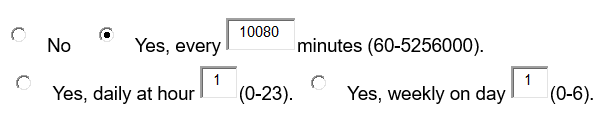
RESTORE FACTORY DEFAULT SETTING
Factory Reset
There are two (2) methods for resetting your unit:
Reset Button
Reset default factory settings following these four (4) steps:
- Unplug the Ethernet cable.
- Locate a needle-sized hole on the back panel of the gateway unit next to the power connection.
- Insert a pin in this hole, and press for more than 4 seconds.
- Take out the pin. All unit settings are restored to factory settings.
IVR Command
Reset default factory settings using the IVR Prompt (Table 5):
- Dial “***” for voice prompt.
- Enter “099” and wait for the “reset” voice prompt.
- Enter the encoded MAC address (Look below on how to encode the MAC address).
- Wait 15 seconds, and the device will automatically reboot and restore factory settings.
Encode the MAC Address
- Locate the MAC address of the device. It is the 12-digit HEX number on the bottom of the unit.
- Key in the MAC address. Use the following mapping:
Key | Mapping |
0-9 | 0-9 |
A | 22 (press the “2” key twice, “A” will show on the LCD) |
B | 222 |
C | 2222 |
D | 33 (press the “3” key twice, “D” will show on the LCD) |
E | 333 |
F | 3333 |
MAC Address Key Mapping
For example: if the MAC address is 000b8200e395, it should be keyed in as “0002228200333395”.
CHANGE LOG
This section documents significant changes from previous versions of the GXW42XX user manuals. Only major new features or major document updates are listed here. Minor updates for corrections or editing are not documented here.
Firmware version 1.0.33.11
Product Name: GXW4216 V2, GXW4224 V2, GXW4232 V2, GXW4248 V2
- Added support for displaying the Serial Number on the System Info page. [Serial Number]
- Added support for the option “Optional” to SRTP Mode. [SRTP Mode]
- Added support for enabling and disabling FXS voltage when the port is disabled. [Enable Voltage Off Upon Port Disabled]
- Added support for the number of digits to strip from the beginning of the Caller ID. [Number of Beginning Digits to Strip from Caller ID]
- Added support for Feature Key Synchronization. [Feature Key Synchronization]
- Added the ability to configure SIP Timer B. [SIP TIMER B]
- Added the ability to configure SIP Timer F. [SIP TIMER F]
- Added support for T.38 Talker Echo Protection (TEP). [Enable T38 TEP]
- Added support for UTF-8 characters in Analog Port Name fields. [Port Settings]
- Added support for a customizable dial tone for call forwarding features on FXS ports. [Dial Tone when Call Forward Active]
- Added support for AES-GCM Encryption in “OpenVPN® Encryption”. [OpenVPN® Encryption]
- Added support for HTTP/HTTPS Proxy settings. [HTTP/HTTPS Proxy]
- Added support for the custom config order feature on the Web UI. [Provision Config Order]
- Added support for enabling Wideband PCM Resolution using P-values. [Wideband PCM Resolution]
- Added support for Caller ID order customization for Vonage. [Caller ID]
- Added option for DHCP option 160 Priority over Option 66. [Allow DHCP Option 43 and Option 66 to Override Server]
- Added support for UDP/RTP checksum. [Local RTP Port]
- Added DNS SRV failover after 5xx responses. [SRV Settings]
- Added option to prevent REGISTER/UPDATE to primary SBC during secondary SBC session. [SRV Settings]
Firmware version 1.0.23.15
Product Name: GXW4216 V1/GXW4224 V1/GXW4232 V1/GXW4248 V1
- Added support for “Add MAC in User-Agent”. [Add MAC in User-Agent]
- Added support for “Use MAC Header”. [Use MAC Header]
- Added support for the MTU feature. [Maximum Transmission Unit (MTU)]
- Added support for “Download and Process All Available Config Files”. [Download and Process All Available Config Files]
- Added support for Provision Config Order. [Provision Config Order]
- Added support for uploading config files in text format. [Upload Device Configuration]
- Added support for “OpenVPN Username” on the VPN Page. [OpenVPN® Username]
- Added support for “OpenVPN Password” on the VPN Page. [OpenVPN® Password]
- Added support for specifying the number of leading digits to strip from caller ID. [Number of Beginning Digits to Strip from Caller ID]
- Added support to display the Serial Number on the System Info page. [Serial Number]
- Added support for Firmware Upgrade Via Resync SIP NOTIFY. [Resync SIP NOTIFY]
- Added support for HTTP version 1.1 when requested by the provisioning server.
Firmware version 1.0.33.3
Product Name: GXW4216 V2/GXW4224 V2/GXW4232 V2/GXW4248 V2
- Changed the default value “Disable Weak TLS Cipher Suites” to “Disable All Of The Above Weak TLS Ciphers Suites”. [Disable Weak TLS Cipher Suites]
- Changed the default value of “Minimum TLS Version” to “TLS 1.2”. [Minimum TLS Version]
- Changed the default value of “Profile Active” to “No”. [Profile Active]
- Changed the default value of “Enable FXS” to “No”. [Enable FXS (TR-069)]
- Changed the default value of “Use Random SIP Port” to “Yes”. [Use Random SIP Port]
- Changed the default value of “Use Random RTP Port” to “Yes”. [Use Random RTP Port]
- Added support for a new option value “TLS 1.3” for “Minimum TLS Version”. [Minimum TLS Version]
- Added support for RFC8760.
- Added support for enabling TR069 through the management interface. [Enable TR069 Through Management Interface]
- Added support for enabling RADIUS through the management interface. [Enable RADIUS Through Management Interface]
- Added support for Vonage IVR diagnostics.
- Added support for an IVR prompt when the WAN cable is disconnected.
Firmware version 1.0.23.11
Product Name: GXW4216 V1/GXW4224 V1/GXW4232 V1/GXW4248 V1
- No major changes
Firmware version 1.0.31.2
Product Name: GXW4216 V2/GXW4224 V2/GXW4232 V2/GXW4248 V2
- Added support for OpenVPN TLS Key. [OpenVPN® TLS Key] [OpenVPN® TLS Key Type]
- Added support for remote access to WebUI via GDMS. [Grandstream Cloud]
- Added support for the Israel time zone with daylight saving time (DST). [Time Zone]
- Added new option “2 – Parallel” to Hunting Group Type (P4395/4396/4397/4398). [Hunting Group Type]
- Update the name of “Request URI Routing ID” (P4669-4700, P21704-21719) to “Routing ID”. [Routing ID]
- Added support for assigning multiple DIDs per FXS port. [Routing ID Matching Type]
- Added the ability to save time to the timefile periodically. [System Information]
- Added support for hostname validation in certificates. [Validate Hostname in Certificate]
- Added support for the MTU feature. [Maximum Transmission Unit (MTU)]
Firmware version 1.0.29.9
Product Name: GXW4216 V2/GXW4224 V2/GXW4232 V2/GXW4248 V2
- Added the ability to detect the connection status of FXS ports. [Enable FXS (TR-069)]
Firmware version 1.0.29.7
Product Name: GXW4216 V2/GXW4224 V2/GXW4232 V2/GXW4248 V2
- Added support for Firmware Upgrade Via ReSync SIP NOTIFY. [Configuration and Firmware Upgrade through Resync SIP NOTIFY]
- Added the “Enable/Disable Access” option to the LCD Menu. [Disable Web Configuration Access]
- Added support for Subscribe Retry Wait Time upon 403 Forbidden. [Subscribe Retry Wait Time upon 403 Forbidden]
- Added support to a “No Key Offhook Auto-dial number” field to trigger off-hook auto-dial when uncompleted numbers. [Special Auto Dial Number for an Incomplete Dial by User]
- Renamed the parameter “OnHook DC Feed Current” to “Maximum DC Feed Current” [Maximum DC Feed Current]
- Added support to initiate a Re-Invite for fax transmission when the fax machine is the sender. [Re-INVITE Upon CNG Count]
- Updated the term “Blacklist” to “Block list”. [Blocklist for WAN Side Port] [Blocklist for WAN side]
- Added support OpenVPN® failover option. [OpenVPN® Server Secondary]
Firmware version 1.0.27.3
Product Name: GXW4216 V2/GXW4224 V2/GXW4232 V2/GXW4248 V2
- Added support to Enable/Disable WEB access through the IVR. [WAN Port Web Access]
- Added support for the “Switch SIP Server When Keep-Alive Max Lost Is Reached”. [Switch SIP Server When Keep-Alive Max Lost Is Reached]
- Added support Conference Notification Tone. [Conference Notification Tone]
- Added support Remote On Hold Tone. [Remote On Hold Tone]
- Added support for Ringing Transfer. [Ringing Transfer]
- Added RTP/RTCP keep alive feature. [RTP/RTCP Keep Alive On Hold]
- Added ability to support Authentication based on Username/Password on OpenVPN®. [OpenVPN® Username][OpenVPN® Password]
- Added support to configure static DNS SRV records. [Static DNS]
- Added support to configure the Strict Password Rules. [Strict Password Rules]
- Added support for XMPP-based connection request. [XMPP]
- Added support for the secondary NTP server. [Secondary NTP server]
- Added ability to set local date and time. [Local Time]
- Added support to configure the T.38 Max Bit Rate. [T.38 Max Bit Rate]
- Update the “Subscribe Retry Wait Time upon 403 Forbidden” max value to 10080 minutes. [Subscribe Retry Wait Time upon 403 Forbidden]
- Added support to save Syslog settings and internal logs across a factory reset. [P82307]
Firmware version 1.0.25.2
Product Name: GXW4216 V2/GXW4224 V2/GXW4232 V2/GXW4248 V2
- Added support to check the certificate information of the device through IVR. [Certification Information]
- Added support of $PN and $MAC variables in Config Server Path. [Config Server Path]
Firmware version 1.0.23.8
Product Name: GXW4216 V1/GXW4224 V1/GXW4232 V1/GXW4248 V1
- Set the “Disable User Level Web Access” (P28158) to “Yes” by default. [Disable User Level Web Access]
- Set the “Disable Viewer Level Web Access” (P28159) to “Yes” by default. [Disable Viewer Level Web Access]
- Force user to change the password upon first login using the default password to the Admin/User/Viewer Account. [Access the Web Configuration Menu]
Firmware version 1.0.25.1
Product Name: GXW4216 V2/GXW4224 V2/GXW4232 V2/GXW4248 V2
- Set the “Disable User Level Web Access” (P28158) to “Yes” by default. [Disable User Level Web Access]
- Set the “Disable Viewer Level Web Access” (P28159) to “Yes” by default. [Disable Viewer Level Web Access]
- Force user to change the password upon first login using the default password to the Admin/User/Viewer Account. [Access the Web Configuration Menu]
Firmware version 1.0.23.2
Product Name: GXW4216 V2/GXW4224 V2/GXW4232 V2/GXW4248 V2
- Added Support for “Keep Security Setting After Reset”. [Keep Security Setting After Reset]
Firmware version 1.0.23.7
Product Name: GXW4216 V1/GXW4224 V1/GXW4232 V1/GXW4248 V1
- No Major Changes.
Firmware version 1.0.21.2
Product Name: GXW4216 V2/GXW4224 V2/GXW4232 V2/GXW4248 V2
- Added a “Provision“ button which lets user provision manually via WebUI. [Provision]
- Changed the order of download config file requests to cfgMAC.xml, cfgMAC, cfgMODEL.xml, and cfg.xml. [Download and Process All Available Config Files]
Firmware version 1.0.19.1
Product Name: GXW4216 V2/GXW4224 V2/GXW4232 V2/GXW4248 V2
- Added new value “Auto” in NAT Traversal. [NAT Traversal]
- Added support for AVS DTMF Detector Parameters. [DSP DTMF Detector Min Level] [DSP DTMF Detector SNR] [DSP DTMF Detector Deviation] [DSP DTMF Detector Twist]
- Added option to use P-Early-Media Header. [P-Early-Media Header]
- Added the ability to force local ringback tone with 180 ringing SDP. [Ringback Tone at No Early Media]
- Added support Radius Auth Protocol. [Radius Auth Protocol]
- Added ability to lock/unlock extension from analog phones using local feature code. [Port Lock Code]
- Added Ability to lock FXS ports. [Lock/Unlock Extension Code]
Firmware version 1.0.17.1
Product Name: GXW4216 V2/GXW4224 V2/GXW4232 V2/GXW4248 V2
- Updated the “Replace Beginning ‘+’ in Caller ID with” support a predefined string. [Replace the beginning ‘+’ in Caller ID with]
- Added the new option “3 – PR” in “Visual MWI type” which sends MWI signaling using Polarity Reversal. [Polarity Reversal]
- Added support the “ = ” sign in config and firmware server path. [Firmware Server Path] [Config Server Path]
- Updated “Prefer Primary SIP Server” options “1 – No” to “1 – Will register to primary server if failover server registration expires, and “2 – Will register to primary server if primary server responds”. [Prefer Primary SIP Server]
Firmware version 1.0.15.2
Product Name: GXW4216 V2/GXW4224 V2/GXW4232 V2/GXW4248 V2
- Add the Ability to specify DTMF timing for InBand. [Custom DTMF InBand Duration]
Firmware version 1.0.13.2
Product Name: GXW4216 V2/GXW4224 V2/GXW4232 V2/GXW4248 V2
- Added support for the MWI Tone. [MWI Tone]
- Added support for the Special Proceed Indication Tone. [Special Proceed Indication Tone]
- Added support for the Special Condition Tone. [Special Condition Tone]
- Added the ability to ignore the alert-info header. [Ignore Alert-Info Header]
- Added the ability to Allow SIP Factory Reset. [Allow SIP Factory reset]
- Added the “Add MAC in User-Agent” configuration. [Add MAC in User-Agent]
- Added support for “Use MAC Header” configuration. [Use MAC Header]
- Added support for “Extra Debug” in Syslog Level. [Syslog Level]
- Update the status page to show the HW version with the model’s name. [Product Model]
- Added the ability to configure special features with GIBTELECOM via TR069. [GIBTELECOM]
Firmware version 1.0.23.6
Product Name: GXW4216 V1/GXW4224 V1/GXW4232 V1/GXW4248 V1
- Added Support to download system information via WebUI. [System info]
Firmware version 1.0.11.2
Product Name: GXW4216 V2/GXW4224 V2/GXW4232 V2/GXW4248 V2
- Added support for Download and Process All Available Config Files. [Download and Process All Available Config Files].
- Added support for Enabling Using tags in URL [Enable using tags in URL]
- Added the new voice prompt *98. [Voice prompt]
- Added the additional Flash digit events in the Special Feature Gibtelecom. [Flash Digit Control]
- Added support for new override config file option in “cfgMAC_override.xml”. [Download and Process All Available Config Files].
Firmware version 1.0.9.1
Product Name: GXW4216 V2/GXW4224 V2/GXW4232 V2/GXW4248 V2
- Added Password length to support up to 30 Characters. [Web and SSH Access]
Firmware version 1.0.7.2
Product Name: GXW4216 V2/GXW4224 V2/GXW4232 V2/GXW4248 V2
- Added support to Define the Preferred Provisioning Method. [Upgrade and Provisioning]
- Added support of DHCP Option 150. [Upgrade and Provisioning]
- Added support for SRTP Key Length. [Profiles]
- Added support for SSL Key Log File. [Ethernet Capture.]
- Added support for Security Controls for SSH Access. [Web and SSH Access.]
- Updated Syslog to make user reading more friendly.
Firmware version 1.0.5.4
Product Name: GXW4216 V2/GXW4224 V2/GXW4232 V2/GXW4248 V2
- Added support to send SNMP traffic through Management Interface. [Network Settings]
- Added support to send Syslog traffic through Management Interface. [Network Settings]
Firmware version 1.0.23.5
Product Name: GXW4216/GXW4224/GXW4232/GXW4248
- Added ability to send SNMP traffic through Management Interface. [Network Settings]
Firmware version 1.0.3.9
Product Name: GXW4216 V2/GXW4224 V2/GXW4232 V2/GXW4248 V2
- No major changes.
Firmware version 1.0.3.4
- This is the initial release version of GXW42xx V2 firmware.
Firmware version 1.0.23.2
- No major changes.
- No Major changes.
- Added support for Play Port Number. [Play Port Number Feature]
- No major changes.
- No major changes.
- Added support for Send Hook Flash Event Method. [Send Hook Flash Event Method]
- Added support for Israel DST time zone. [Time Zone]
- Added support for validating subject alternative name when “Validate Server Certificates” is enabled. [Validate Server Certificates]
- Added support for SIP User-Agent Header. [SIP User-Agent]
- Increased RX Gain by adding “Force + x dB” options. [Gain]
- Added support for DHCP Option 67. [Download and Process All Available Config Files]
- Added support to configure Minimum/Maximum TLS versions. [Minimums TLS Version][Maximum TLS Version]
- Added feature RFC2543 Hold. [RFC2543 Hold]
- Added feature Syslog Protocol. [Syslog Protocol]
- Added feature to configure distinctive call waiting tones. [Call Waiting Tones]
- Added feature “SIP Log Option”. [SIP Log Option]
- Added support to keep CDR record. [CDR record option]
- Added Feature “Disable Weak TLS Cipher Suites”. [Disable Weak TLS Cipher Suites]
- Added feature “Disable Reminder Ring for DND”. [Disable Reminder Ring for DND]
- Added feature “Callee Flash to 3WC”. [Callee Flash to 3WC]
- Added feature “Connection Request Port” for TR-069. [Connection Request Port]
- Added support for DHCP Option 82. [Client Circuit ID (Option 82)][Remote Agent ID (Option 82)]
- Added feature “Local DNS Setting”. [Local DNS Setting]
- Added support to send SNMP trap to 3 different servers. [SNMP Trap IP]
- Added Russian language support on Web UI and IVR. [IVR Language][Configuring GXW42XX with Web Browser]
- Added feature “Use Actual Ephemeral Port in Contact with TCP/TLS”. [Use Actual Ephemeral Port in Contact with TCP/TLS]
- Added feature “Reset Call Features”. [Reset Call Features]
- Added feature “Replace Beginning ‘+’ with 00 in Caller ID. [Replace Beginning ‘+’ with 00 in Caller ID]
- Added support to display call feature status on Web UI. [Call Features Status]
- Increased TX Gain and RX Gain range from (-6dB – 6dB) to (-12dB – 12dB). [Gain]
- Added support to allow “Name” configured under “FXS Ports” for ports that are part of the active hunting group to take effect. [FXS Name]
- No Major changes.
- Change Feature “Validate Server Certificates” default value to No. [Validate Server Certificates]
- Added feature “Enable SIP OPTIONS/NOTIFY Keep Alive”. [Enable SIP OPTIONS/NOTIFY Keep Alive]
- Added feature “Call Record” to download the call history records from Web GUI. [Call Record]
- Added feature Conference Party Hangup Tone. [Conference Party hangup tone]
- Added feature Inter-port Calling. [Inter-port Calling]
- Added feature LED Pattern. [LED Pattern]
- Added feature Reply to ICMP. [Reply to ICMP]
- Added feature Validate Server Certificates. [Validate Server Certificates]
- Added feature Load CA Certificates. [Load CA Certificates]
- Added feature Disable User Level Web Access. [Disable User Level Web Access]
- Added feature Disable Viewer Level Web Access. [Disable Viewer Level Web Access]
- Added feature Randomized Automatic Upgrade. [Randomized Automatic Upgrade]
- Added feature Virtual Network Interface. [Network settings for Management Interface]
- Added feature Disable Voicemail Reminder Tone. [Disable Voicemail Reminder Tone]
- Added feature Disable # as Redial Key. [Disable # as Redial key]
- Added feature Ringing Frequency. [Ringing Frequency]
- Added support for call waiting tone to be repeated while the caller is still calling. [Call Waiting]
- Added support to play stutter tone when call feature under Profiles → Call Features Settings is enabled. [Enable Call Features]
- Added support for Allow Auto-Dial Config Per Port. [Allow Auto-Dial Config Per Port]
- Added RTCP support. [RTCP]
- Added Custom Certificate support. [Custom Certificate]
- Added support for HTTPS server based on TLSv1.2. [HTTP/HTTPS User Name]
- No major changes.
- Added option to specify the priority for caller ID display [Caller ID Display]
- Added option to save syslog locally. [Save Syslog]
- Added option “Prefer Primary Outbound Proxy” to enable registration through primary outbound proxy if registration expires. [Prefer Primary Outbound Proxy]
- Added feature “Whitelist for WAN side” and “Blacklist for WAN side” for remote management. [Access Control Lists]
- Added feature” Lockout time interval” to change banning time after too many failed login attempts. [Lockout Time Interval].
- Added option “Web Access Mode” to choose between “HTTPS” and “HTTP” to access device Web UI. [Web Access Mode]
- Added option “HTTPS Web Port” to set HTTPS web port instead of using default web port. [HTTPS Web Port]
- Added local firmware upgrade support. [Upload Device Firmware]
- Change “Disable Telnet” option to “Disable SSH” option for more security. [Disable SSH]
- Added option [DTMF-RELAY Tag Respect SIP INFO] [Use Request Routing ID in SIP Headers] for Profile 1-4 audio settings.
- Added the option of [Crypto Life Time] to support RTP settings.
- Added option [Play busy/reorder tone before Loop Current Disconnect] for Profile 1-4 audio settings.
- Added the option of [Disable Connected Line ID] to support not display the connected line ID.
- Added the option of [Flash Digit Control] [Crypto Life Time] to overrides the default settings for call control.
- Added option to configure [Local RTP port].
- Added the option to configure [SIP Registration Failure Retry Wait Time upon 403 Forbidden].
- Added the option to enable/disable [Hold Target Before Refer].
- Added the option to enable/disable [Authenticate server certificate domain].
- Added the option to enable/disable [Authenticate server certificate chain].
- Added the option to configure [Trusted CA]
- Added the function of [Automatic Reboot].
- Added the option to [Allow DHCP Option 42 to NTP Server] to support Time and Date settings.
- Added the option to [Allow DHCP Option 2 to override time zone] to support Time and Date settings.
- Added the option to enable/disable [3CX Auto Provision] to support multicast SUBSCRIBE for provision.
- Added option [SIP REGISTER Contact Header Uses] [Use Request Routing ID in SIP Headers] for Profile 1-4 to support NAT transfer feature.
- Added option [Enable Fast RFC2833] to set DTMF duration by RFC2833.
- Added SNMP support.[SNMP]
- Added QoS settings for SIP and RTP packets. Rearranged options [Layer 2 QoS Settings] and [Layer 3 QoS Settings].
- Added star code [*98] to play registration ID
- Added star code [*99] to trigger provisioning process.
- Added support to download device configuration file. [Download Device Configuration]
- Added support for audio codec G.722. [Preferred Vocoder (Codec)]
- Added option [Always send HTTP Basic Authentication Information] to enable sending HTTP authentication without server challenge
- Added the options to enable/disable [Use P-Preferred-Identity Header] and [Use Privacy Header]
- Added the options to enable/disable [Do Not Escape ‘#’ as %23 in SIP URI]
- Added [Use Request Routing ID in SIP Headers] to enable/disable device to use configured Request URI Routing ID for certain FXS port in its SIP message Header when a trunk SIP account is used.
- Added option [Add Auth Header on Initial REGISTER] to enable/disable including authentication header in the initial REGISTER.
- Added option [Enable LLDP] to enable/disable LLDP.
- Added field [Request URI Routing ID] to allow device to route the calls to individual FXS ports based on the DID, when only have one sip registration.
- Added option [Display Language] to choose language for LCD display.
- Added option [Prompt Dial Tone Code] to configure dial code.